Quick answer: An electric panel (also called a breaker panel or breaker box) is the metal box that takes power from your utility meter and splits it into your home’s circuits. Each circuit has its own breaker that shuts off if the circuit is overloaded. Panels are rated in amps, commonly 100 or 200 amps, and home solar connects through the panel.
Key takeaways
- The main breaker shuts off power to the whole house; each branch breaker trips when its circuit draws more current than its wiring can safely carry.
- Home solar panels connect at the electric panel: the inverter’s AC output feeds a breaker (or a tap ahead of the main breaker), and power you don’t use flows out to the grid through your meter.
- Older or smaller panels may need an upgrade before you add solar, a battery or an EV charger; a Licensed Electrical Contractor decides with a load calculation.
- In Ontario, panel and service changes need an Electrical Safety Authority (ESA) permit, and service upgrades are booked with your local utility.
What is an Electric Panel?
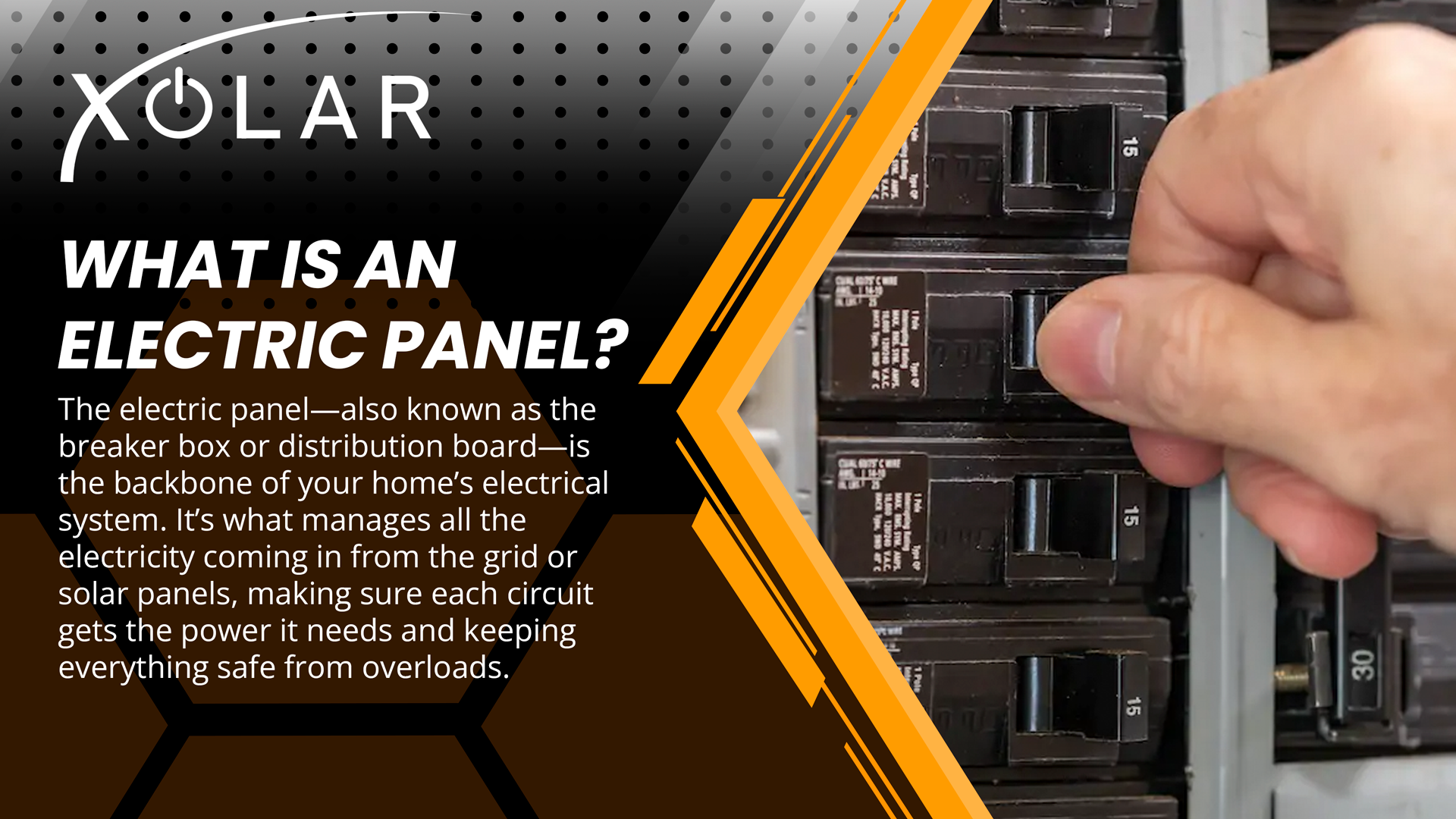
The electric panel, also known as the breaker box or distribution board, is the backbone of your home’s electrical system. It’s what manages all the electricity coming in from the grid or solar panels, making sure each circuit gets the power it needs and keeping everything safe from overloads. When you add solar panels to your home, they connect to this panel, so it’s worth knowing how it works.
The electrical panel, often tucked away in a garage, basement, utility room, or even outside, draws in electricity from your utility company or solar setup. From there, it channels power to circuits that keep your home running, whether it’s the lights, kitchen appliances, or your heating and cooling system. An energy monitor for your solar home installed at the panel shows what each of those circuits uses.
Key Components of an Electric Panel:
- Main Breaker: The master switch of your home’s electricity, controlling the entire power flow. It can shut everything down during maintenance or an emergency.
- Circuit Breakers: These safety switches cut power to a circuit if it’s drawing too much. They prevent overheating, reduce fire risks, and keep your appliances safe.
- Bus Bars: Metal strips that connect the main breaker to each circuit, creating the pathway for electricity to flow from the grid to every room.
- Grounding: The safety net of your system, providing a safe path for excess electricity, like from lightning or surges, to discharge harmlessly into the ground.
How Does an Electric Panel Work?
Electricity enters your home through the electric panel, which then distributes it through individual circuits. Each circuit powers a specific area of your home or certain appliances. If the current flowing through a circuit exceeds its capacity, the circuit breaker trips, cutting off power to that circuit to prevent overheating or damage. In this way, the electric panel not only distributes power but also provides a layer of protection by regulating and controlling the electricity flowing through your home.
How does the Electrical Panel work with your Solar Setup?
In a solar energy system, your electric panel is key to integrating solar power into your home’s setup. With a string inverter, the inverter is usually mounted near the electrical panel and the solar array feeds the panel through it; with microinverters, the conversion happens at each panel on the roof (see string vs micro inverters). The electrical panel directs solar energy from the inverter to balance energy from both your panels and the grid.
When your solar panels produce power, it starts as direct current (DC) electricity. The solar inverter then converts it to alternating current (AC), the form your home and grid use. From there, your electric panel takes over, distributing this AC power to your devices and appliances. If there’s extra, it flows out to the grid through your bi-directional meter. In Ontario, net metering turns those exports into bill credits that carry forward for up to 12 months before they expire (O. Reg. 541/05). Homes that take the Home Renovation Savings Program solar rebate cannot also net meter.
The electric panel manages this flow of electricity between solar and grid power. During peak sunlight, your panels might produce more than you need. With a grid-tied system, that surplus flows back to the grid for potential credits. If you have a battery backup, that excess is stored for later, like at night or on cloudy days.
Not every electric panel can handle the extra load from solar, especially older ones. For some homes, a panel upgrade might be needed to safely handle the boost in power and meet today’s safety standards. Upgrading ensures your system runs smoothly, making the most of your solar setup.
How Do You Know if You Need an Electric Panel Upgrade?
If your electric panel is older or low on capacity, it might need an upgrade before you add solar panels. Here’s what to look out for. If circuit breakers keep tripping, your panel could be overloaded. Constant trips are a clear sign it’s struggling to handle the power demand. Panels installed decades ago were often sized for smaller loads than today’s homes use, before anyone added solar, a battery or an EV charger. Panels are rated in amps, and going from 100-amp to 200-amp service is a common upgrade (Hydro Ottawa). Whether your home needs one depends on a load calculation by a Licensed Electrical Contractor, your panel’s rating and free breaker space, and the size of the solar or battery system. In Ontario, you must apply for an ESA permit before changing your electrical service, and your utility schedules the work (Hydro One). Upgrading ensures your solar system works seamlessly, keeping your home safe and up to code.
Frequently asked questions
Is a breaker box the same as an electrical panel?
Yes. Electrical panel, electric panel, breaker panel, breaker box, service panel and distribution board all describe the same thing in a home: the metal enclosure where power from the utility meter is split into circuits, each protected by its own breaker. Very old homes may have a fuse box instead, which does the same job with fuses rather than resettable breakers.
Get your exact solar price
A free, no-obligation quote and custom design for your home — in about 24 hours.
Get Your Free Solar Quote
Get a personalized solar proposal in 24 hours
Prefer to discuss your project first? Contact us or view our detailed quote form
How does an electrical panel work?
Power arrives from the utility through your meter and the main breaker, which feeds metal bus bars inside the panel. Each branch breaker clips onto the bus bars and sends power to one circuit, such as the kitchen outlets or the furnace. If a circuit draws more current than its wiring is rated for, its breaker trips and cuts power to that circuit only.
Where is the electrical panel in a house?
Panels are usually in the basement, garage, utility room or laundry area, often on a wall close to where the power line and meter enter the house. Some homes have the main panel outside, or a second, smaller panel (a subpanel) in a garage or addition. Keep the area in front of the panel clear so you can reach it quickly.
What size electrical panel does a house need?
Home panels are rated in amps, and 100-amp and 200-amp services are common. The right size comes from a load calculation that adds up heating, cooking, laundry, air conditioning and any EV charger, heat pump or battery. A Licensed Electrical Contractor does that calculation. If you need more capacity, your utility has to upgrade the service, and an ESA permit is required.
Do I need to upgrade my electrical panel for solar panels?
Not always. Many panels can take a solar connection as they are. Electrical code rules limit how much inverter output can feed back through a panel’s bus bars, so the installer checks the panel rating, the main breaker size and free breaker space. If the panel is too small or full, the options are a connection on the supply side of the main breaker or a panel upgrade.
Why does my breaker keep tripping?
A breaker trips when its circuit draws more current than it is rated for, when there is a short circuit, or, for ground fault and arc fault breakers, when it senses a fault. Frequent trips usually mean too many appliances on one circuit or a wiring or appliance problem. Unplug some loads and reset it once; if it keeps tripping, call a Licensed Electrical Contractor.
Can I work on my own electrical panel in Ontario?
Ontario homeowners may do electrical work in their own home, but it must follow the Ontario Electrical Safety Code, and the required notification of work (permit) must be filed with ESA. If you hire someone, it must be a Licensed Electrical Contractor (ESA). A panel or service upgrade also involves your local utility, which has to schedule the service work.
What is a smart electrical panel?
A smart (digital) electrical panel adds monitoring and control to the breakers, so you can see what each circuit uses and switch some circuits on or off from an app. Some can turn off low-priority circuits during an outage to stretch a backup battery. A regular panel with a separate energy monitor gives you much of the same usage data.
Get a State-of-the-Art Setup with XOLAR
Your electric panel is the heart of your home’s electrical system, safely distributing power to every circuit. In a solar setup, it’s even more essential, managing and channeling the electricity your solar panels produce. If you’re considering going solar, make sure your panel is up-to-date and ready to handle the extra power to keep everything running smoothly.
Interested in going solar?
The first step is to acquire a solar proposal. By understanding your energy consumption, sunlight exposure, and roof orientation and space, we can design a solar solution that meets your needs both now and in the future. A well-sized solar system can help you achieve your energy goals and reduce your carbon footprint.
Our Solar Specialists and Project Managers can cleanly walk you through the steps of what is required and make sure you maximize the value of any provincial or federal programs in your area. We’ll also get you started on the vital first step of acquiring a tailor-made solar proposal for your residential project’s energy needs.
Schedule a consultation for our solar specialist’s expert guidance here.