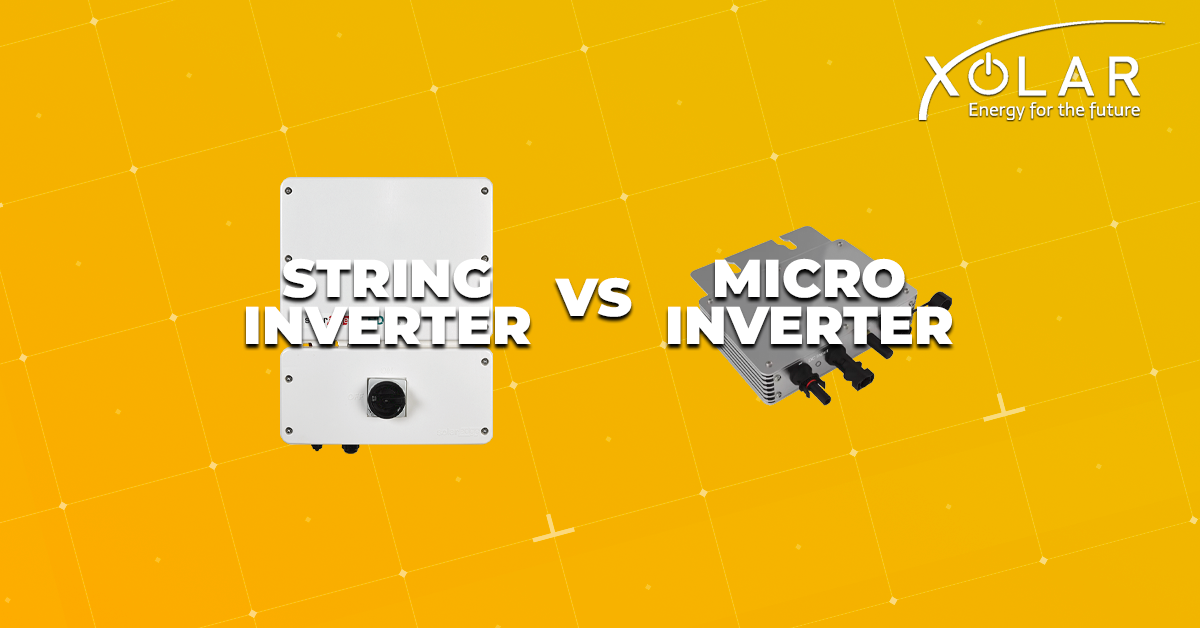
Quick answer: A string inverter converts the power from a whole row of panels in one central box; a micro inverter sits under each panel and converts its power on the roof. String systems are usually the lower-cost choice for an unshaded roof. Micro inverters cope better with shade and panels on several roof faces.
Key takeaways
- Both types do the same job: they turn the DC power your panels make into the AC power your home and the grid use. Our guide to residential solar panels covers the rest of the system.
- A string inverter is one central unit. Shade on one panel can pull down the output of every panel on the same string.
- Micro inverters work panel by panel, so one shaded or dirty panel does not drag down the rest, and you can see each panel’s output.
- In Ontario, systems on buildings need rapid shutdown under the Ontario Electrical Safety Code. Micro inverters may meet it on their own; string systems usually add power optimizers.
- Warranties differ by brand: Enphase gives its IQ8 micro inverters 25 years, while SolarEdge covers its inverters for 12 years and its optimizers for 25.
What is a solar inverter?
When it comes to installing solar for your home, it’s important to select a provider that uses high quality panels, but the next most important component in your system is your solar inverter. There are two types of solar inverters: the string inverter and the micro- inverter. But what exactly is a string inverter, and how does it compare to micro inverters? We’ll break down both types below and when each one makes sense for a home, including how solar optimizers work with string inverters.
Solar panels generate direct current (DC) electricity from sunlight (see how a solar panel works). However, most homes and appliances use alternating current (AC) electricity. The inverter’s job is to convert the DC electricity produced by the solar panels into usable AC electricity for your home.
What is a String Inverter?
A string inverter is a central inverter that connects a series (or “string”) of solar panels together. All the DC electricity generated by the connected panels is sent to a single inverter, where it is converted into AC electricity.
How String Inverters Work:
- Panel Connection: Solar panels are connected in series, forming a “string.”
Multiple strings can be connected to a single string inverter. Essentially your entire
solar installation would be connected to the one string inverter. - Centralized Conversion: The DC electricity from the entire string is fed into the
string inverter, which converts it to AC electricity. AC electricity is the type of
electricity that is usable by your home and the grid. - Power Distribution: The converted AC electricity is then distributed to your home
for use, with any excess potentially being sent back to the grid through net metering.
What is a Micro Inverter?
A micro inverter is a small inverter installed directly on each individual solar panel. Instead of a single inverter handling the conversion for multiple panels, each panel has its own dedicated micro inverter that converts the DC electricity to AC right at the source.
How Micro Inverters Work:
- Panel-Level Conversion: Each solar panel has its own micro inverter attached to it.
The DC electricity generated by each panel is converted to AC immediately by its
respective micro inverter. - Independent Operation: Since each panel operates independently, shading, dirt,
or damage to one panel doesn’t significantly affect the output of the others. - Power Distribution: The AC electricity from each panel is then combined and sent
to your home for use, just like with a string inverter system.
Comparing String Inverters and Micro Inverters
While both string inverters and micro inverters serve the same basic function, converting DC to AC electricity, they do so in different ways, with distinct advantages and disadvantages.
Advantages of String Inverters:
- Cost-Effective: String inverters are generally more affordable than micro inverters,
both in terms of initial cost and long-term maintenance. This makes them a more
cost-effective solution for most home solar installations. - Proven Reliability: String inverters have been used for decades in solar
installations and have a proven track record of reliability. They are robust and
durable, making them a dependable choice for homeowners. The trade-off is that a string inverter is a single point of failure: if it stops, the whole array stops until it is repaired or replaced. - Simpler Installation and Maintenance: Since only one string inverter is needed for
an entire solar system, installation is simpler and often quicker than with micro
inverters, which require individual installation on each panel. A string inverter usually sits on a wall near your electrical panel, so it is easy to reach if it ever needs service. - Efficient in Unshaded Areas: If your roof is free from shading and your panels are
installed at the same angle and orientation, a string inverter system will operate
efficiently, maximizing the energy production from your solar panels.
Advantages of Micro Inverters:
- Panel-Level Optimization: Micro inverters optimize the performance of each individual panel. This matters most on roofs with partial shade from trees or chimneys, or with panels split across several roof faces, where one weak panel would otherwise pull down the others on its string. The trade-off is more electronics on the roof: if a micro inverter fails, someone has to go up on the roof to replace it.
- Scalability: If you plan to expand your solar system in the future, adding more panels is easier with micro inverters since each new panel simply gets its own inverter.
- Increased Monitoring Capabilities: Micro inverters often come with panel-level monitoring, allowing you to see the performance of each individual panel. This can help identify issues more quickly. String systems with power optimizers can offer panel-level monitoring too.
When a String Inverter Is the Better Fit
A string inverter is often the better fit for a home with an unshaded roof where the panels face one direction. The lower cost of string inverters makes them a more budget-friendly option, allowing homeowners to invest in higher-quality panels or other system enhancements. With fewer components on the roof, installation is simpler, and there is one main unit to look after.
If your roof is unshaded and your panels are installed uniformly, a string inverter system will also deliver excellent performance without the added cost of micro inverters. With only one inverter to monitor, maintenance is straightforward and constant monitoring isn’t required. If the inverter does fail, there is one unit to replace, usually without going on the roof.
When Micro Inverters Are the Better Fit
Micro inverters, or a string inverter with power optimizers, earn their extra cost when part of the roof is shaded for some of the day, when panels face more than one direction, or when you expect to add panels later. Each panel works on its own, so a shaded or dirty panel does not drag down the rest. Our guide to choosing solar equipment covers the other parts of the decision.
Get your exact solar price
A free, no-obligation quote and custom design for your home — in about 24 hours.
Get Your Free Solar Quote
Get a personalized solar proposal in 24 hours
Prefer to discuss your project first? Contact us or view our detailed quote form
Rapid Shutdown and Warranties in Ontario
Rule 64-218 of the Ontario Electrical Safety Code requires PV systems on or in buildings to have a rapid shutdown that brings wiring more than 1 m from the array down to 30 V or less within 30 seconds, so firefighters can work safely. The Electrical Safety Authority’s Bulletin 64-6-4 notes that micro inverter systems may comply on their own. String systems typically need power optimizers or other module-level shutdown devices, unless the inverter sits within 1 m of the array.
Warranties also differ by brand. Enphase backs its IQ8 micro inverters with a 25-year limited warranty. SolarEdge’s limited product warranty covers its inverters for 12 years and its power optimizers for 25 years. Check the warranty for the exact model in your quote; your panels are covered separately by the panel manufacturer’s warranty.
Frequently asked questions
Which is better for a home, a micro inverter or a string inverter?
Neither wins on every roof. A string inverter is usually the lower-cost choice for an unshaded roof where all the panels face the same way. Micro inverters, or a string inverter with power optimizers, are worth the extra cost when trees, chimneys or dormers shade part of the array, or when the panels sit on two or more roof faces.
Are micro inverters more efficient than string inverters?
Not in the conversion itself: both turn DC into AC with small losses. The difference shows up on imperfect roofs. On a string, the weakest panel limits the others, so shade on one panel costs output across the whole string. Micro inverters let each panel produce what it can, so a partly shaded roof usually yields more energy with micro inverters or optimizers.
Do micro inverters cost more than a string inverter?
Usually, yes, because you buy one inverter per panel instead of one for the whole array. On Xolar’s current price list, an 8 kW solar-only system is $23,800 to $26,000 before tax, installed. The range reflects equipment choice, from a Growatt string inverter to SolarEdge with power optimizers. Your quote shows the price for the equipment that suits your roof.
Can I add more solar panels later with micro inverters or a string inverter?
Yes with either, but it is simpler with micro inverters: each new panel gets its own inverter, so you can add panels without changing the existing equipment. With a string inverter, you need spare capacity in the inverter or a second inverter. If you expect to expand, say so before the first install so the wiring and inverter can be sized for it.
What happens to a string inverter system when one panel is shaded?
Panels on a string are wired in series, so the current through the string is limited by the weakest panel. Shade on one or two panels can lower the output of the whole string, not just the shaded panels. Bypass diodes inside the panel limit the loss, and power optimizers or micro inverters reduce it further by letting each panel work at its own best point.
How long are solar inverter warranties?
It depends on the brand. Enphase gives its IQ8 micro inverters a 25-year limited warranty. SolarEdge covers its inverters for 12 years and its power optimizers for 25 years. Other string inverter brands set their own terms, so check the warranty sheet for the exact model in your quote and note when the warranty period starts.
What is a hybrid inverter?
A hybrid inverter is a string inverter that can also charge and discharge a home battery. It takes DC power from the panels and from the battery and supplies AC power to your home, so you can store solar power for the evening and, with the right setup, for outages. If you plan to add a battery later, ask whether your inverter can run one before you buy.
Do solar systems in Ontario need rapid shutdown?
Yes, for systems on or in buildings. Rule 64-218 of the Ontario Electrical Safety Code requires a rapid shutdown that brings conductors more than 1 m from the array down to 30 V or less within 30 seconds. Micro inverter systems may comply on their own. String systems typically use optimizers or other module-level devices, unless the inverter sits within 1 m of the array.
Get the right system for your home with XOLAR
The right inverter depends on your roof more than on a rule of thumb. On an unshaded roof facing one direction, a string inverter keeps costs down. On a shaded roof or one with several faces, micro inverters or optimizers recover output that a single string would lose.
The goal is a system that covers as much of your electricity use as your roof allows, without adding something else to manage. Our Solar Specialists look at shade, roof faces and your budget before recommending an inverter.
If you’re looking to go solar, our Solar Specialists and Project Managers can cleanly walk you through what type of system is needed to cover your energy needs and make sure you maximize the value of any government programs in your area. We’ll also get you started on the vital first step of acquiring a tailor-made solar proposal for your personal energy needs at home.
Schedule a consultation for our solar specialist’s expert guidance here.