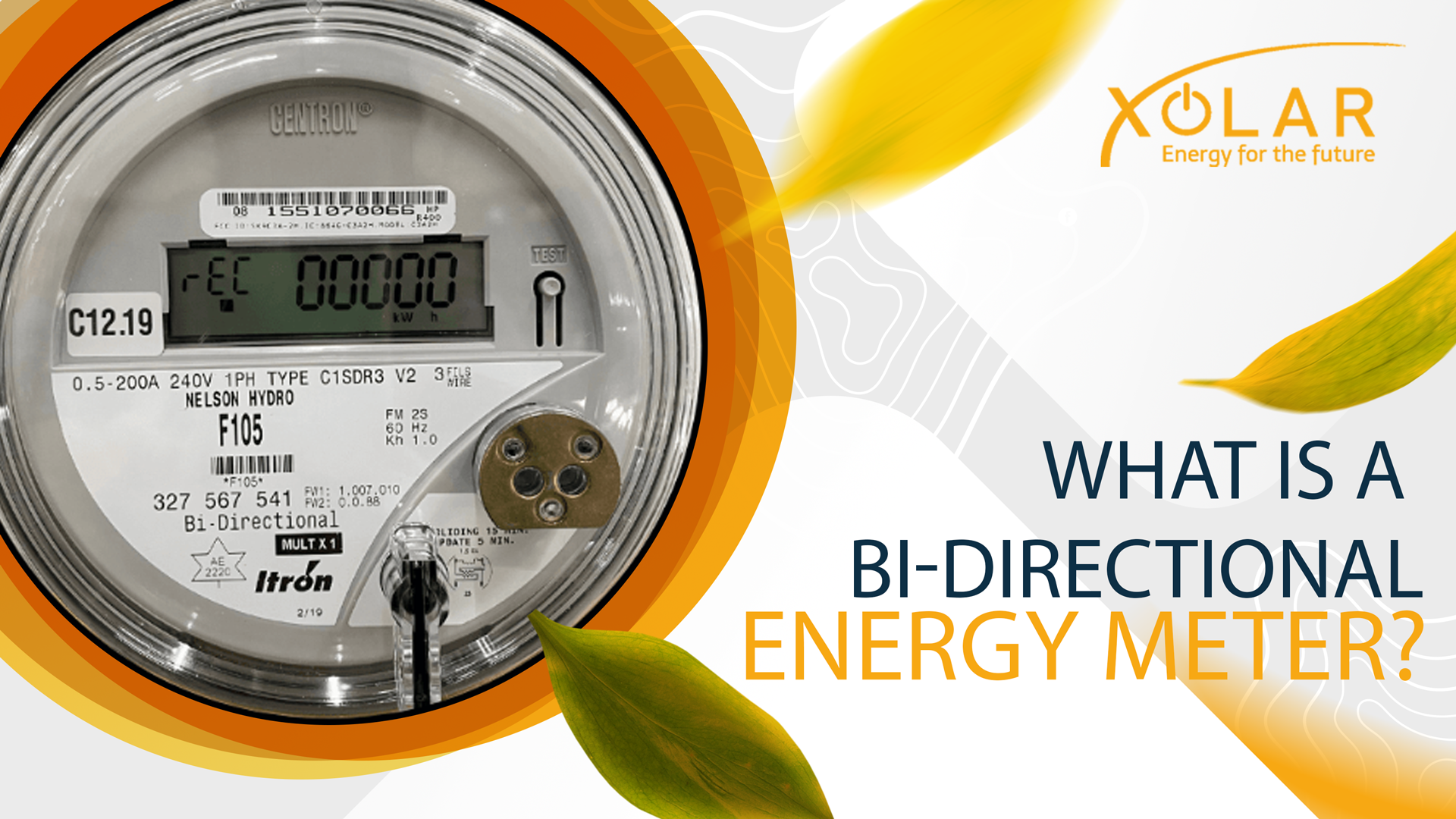
Quick answer: A bi-directional meter measures electricity in both directions: the kWh your home takes from the grid and the kWh your solar panels send back to it. In Ontario, you need one for net metering. Your local utility supplies it, and the kWh you export become bill credits that expire if they are still unused after 12 months.
Key takeaways
- A bi-directional (two-way) meter keeps two registers: kWh delivered to your home and kWh your home sends back to the grid.
- It is required for net metering in Ontario, where exported electricity earns bill credits that carry forward for up to 12 months.
- Exports are valued the same way as the power you buy, so on Time-of-Use pricing, daytime exports earn daytime prices.
- The meter only sees what crosses it, so your total solar production comes from your inverter or an energy monitor.
- If you take the Home Renovation Savings Program solar rebate, you cannot net meter.
What is a Bi-Directional Meter?
A bi-directional meter is a type of electricity meter that measures energy flowing in two directions. Unlike a standard meter that only tracks how much electricity your home consumes; a bi-directional meter also tracks the excess electricity your home sends back to the grid. This is particularly important for homes with solar panels, as it allows homeowners to measure both the energy they consume from the grid and the excess energy their solar panels produce.
How a Bi-Directional Meter Works:
- Measuring Energy Consumption: Just like a traditional meter, a bi-directional meter records how much electricity your home uses from the grid, in kilowatt-hours (kWh). This includes any electricity consumed when your solar panels aren’t producing enough power, such as during the night or on cloudy days.
- Measuring Energy Production: In addition to tracking energy consumption, the bi-directional meter measures the excess electricity generated by your solar panels that is sent back to the grid. This typically happens during the day when your solar panels produce more energy than your home is using.
- Net Energy Flow: The meter keeps track of both the energy consumed and the energy sent back to the grid, allowing you and your utility company to calculate the net energy flow. If you send more electricity to the grid than you use, your utility may credit your account, a system commonly referred to as net metering.
The Role of a Bi-Directional Meter in Home Solar
For homeowners with solar energy systems, a bi-directional meter is an essential component of understanding and optimizing energy usage. It shows how much electricity your home sends to the grid and how much it still takes from it. It does not show your total solar production, because power your home uses directly never passes through it; your inverter app or an energy monitor shows that.
It is also required as part of your net metering agreement with your power company. Net metering is a billing agreement with your power company that lets the electricity you export offset the electricity you buy later. Under net metering, you receive credits for the excess electricity your solar panels send to the grid. Credits carry forward for up to 12 months and then expire, and they cannot reduce fixed monthly charges (O. Reg. 541/05; Hydro One). If you take the Home Renovation Savings Program solar rebate, you cannot sign a net metering agreement; the system must be designed to power your home only. Your bi-directional meter tracks this flow and ensures you’re credited for the energy you’ve contributed.
With a bi-directional meter, you can better monitor your energy production and consumption. This helps you make informed decisions about your energy usage, such as when to run high-energy appliances during peak solar production hours. By aligning your energy usage with your solar output, you can maximize the savings from your solar investment.
But there is an even more effective way to use energy with solar if you are on a Time-of-Use billing plan.
If you are on a Time-of-Use billing plan, the excess energy your solar panels export is credited at the price for the hour you export it, the same way your usage is billed (O. Reg. 541/05). On summer weekdays, on-peak runs from 11 a.m. to 5 p.m. at 20.3¢ per kWh, while evenings after 7 p.m. and weekends are off-peak at 9.8¢ (OEB prices for November 1, 2025 to October 31, 2026). This means that instead of using more energy when your solar panels are producing at their maximum, you can shift some energy usage to a time when rates are lower and generate even more credits. Your exports earn credits at daytime Time-of-Use prices, and the power you use later is billed at lower off-peak prices. This is a form of energy arbitrage.
Frequently asked questions
What does a bi-directional meter do?
It records two numbers: the electricity your home draws from the grid and the electricity your home sends to the grid. Hydro One describes its smart bi-directional meter as a dual-register meter measuring kWh delivered and kWh received (Hydro One conditions of service). Your utility uses both readings to bill you under net metering and to work out your credits.
Do I need a bi-directional meter for solar panels?
You need one if you net meter, because your utility has to measure what you export to credit you for it. If you take the Home Renovation Savings Program solar rebate, you cannot net meter, and the system is designed to power your home only. In that case, ask your utility what metering it requires for your connection.
Get your exact solar price
A free, no-obligation quote and custom design for your home — in about 24 hours.
Get Your Free Solar Quote
Get a personalized solar proposal in 24 hours
Prefer to discuss your project first? Contact us or view our detailed quote form
Who installs a bi-directional meter in Ontario?
Your local utility supplies and installs the meter as part of connecting your solar system, and net metering meters must be approved by Measurement Canada. Your installer applies to the utility first: Hydro One, for example, asks for a Micro Generation Connection Application (Form C) for projects of 12 kW or less (Hydro One net metering). The meter is set up before net metering starts.
How much does a bi-directional meter cost?
There is no single price. Ontario’s net metering regulation allows your utility to bill you for the incremental metering and other costs of connecting your solar system, so the charge depends on your utility and on whether your existing meter can be used. Ask your utility for its current charge before you sign, and check whether your solar quote covers it.
Is my smart meter already bi-directional?
Not necessarily. A standard smart meter is set up to record the electricity you use. For net metering, your utility needs a meter that keeps separate registers for electricity delivered and electricity received. When you apply to connect solar, your utility will tell you whether your current meter can be used or needs to be replaced.
How do I read a bi-directional meter?
Displays vary by model, but many bi-directional meters scroll through several readings, including one register for kWh delivered to your home and one for kWh received from it. Your utility can tell you which display codes mean which. Your net metering bill also lists both amounts and your credit balance, which is usually easier than reading the meter.
What happens to extra solar credits in Ontario?
Credits roll forward from bill to bill. If credits have been carried forward in every billing period for 12 months, the remaining balance is reduced to zero (O. Reg. 541/05). Unused credits are not paid out, so solar systems are usually sized to cover about a year of your own use rather than to produce a large surplus.
Does a bi-directional meter measure how much my solar panels produce?
No. It only sees electricity crossing between your home and the grid. Solar power your home uses directly, such as running the fridge at noon, never reaches the meter. To see total production, use your inverter’s monitoring app or an energy monitor; to see what you exported and bought, use your meter readings or your bill.
Get a state-of-the-art Setup with XOLAR
A bi-directional meter is essential for homeowners with solar energy. It not only tracks the electricity your home uses but also measures the energy your solar panels produce and send back to the grid. The meter is required for net metering, so you get credit for every kWh you export, and it is how solar exports can offset much of your electricity bill. Read more about how net metering benefits a home solar setup.
Interested in learning more about going solar?
The first step is to acquire a solar proposal. By understanding your energy consumption, sunlight exposure, and roof orientation and space, we can design a solar solution that meets your needs both now and in the future. A well-sized solar system can help you achieve your energy goals and reduce your carbon footprint.
Our Solar Specialists and Project Managers can cleanly walk you through the steps of what is required and make sure you maximize the value of any provincial or federal programs in your area. We’ll also get you started on the vital first step of acquiring a tailor-made solar proposal for your residential project’s energy needs.
Schedule a consultation for our solar specialist’s expert guidance here.