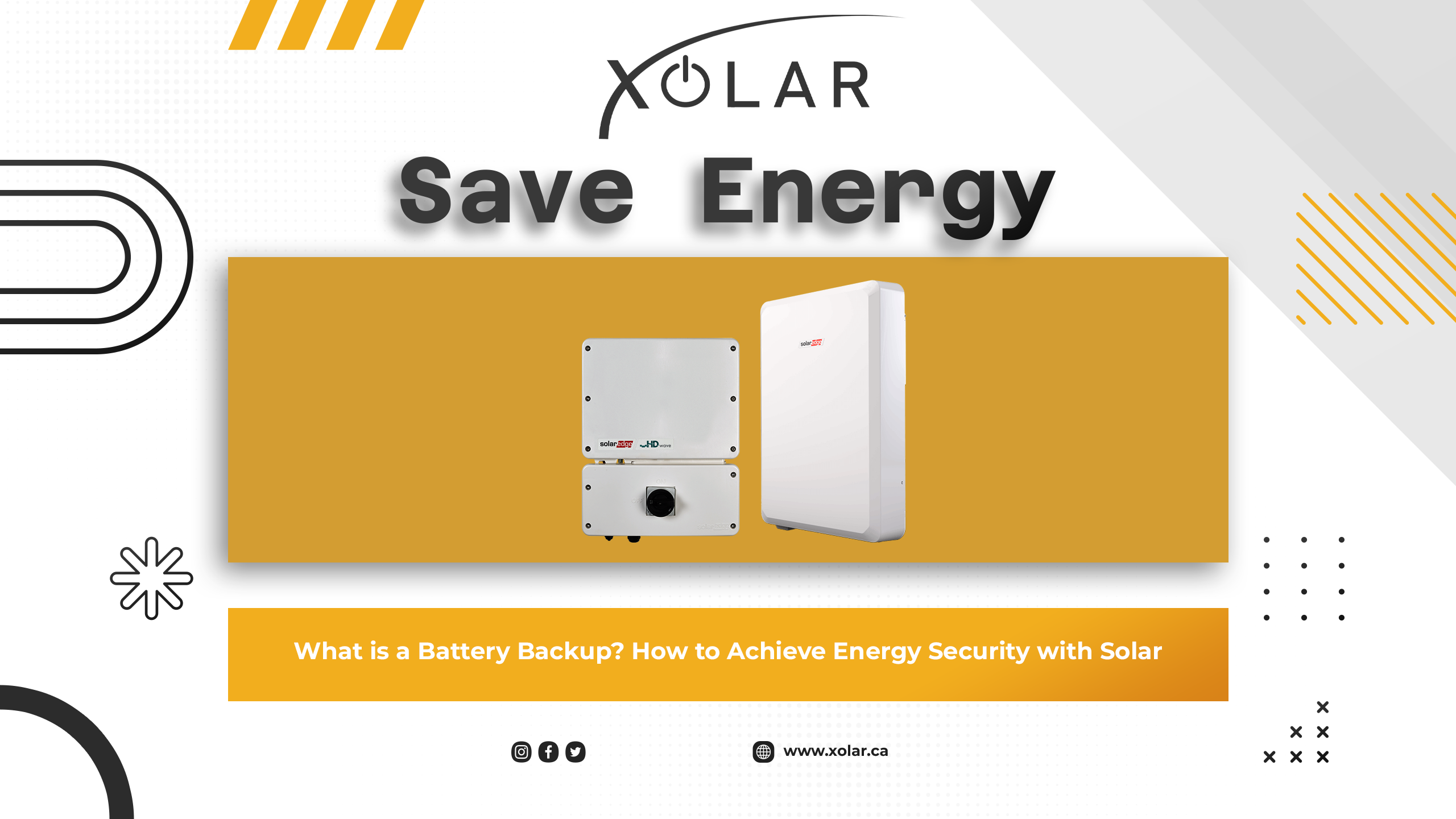
Quick answer: A solar battery backup stores power from your solar panels so your home can use it at night, during peak-price hours, or when the grid goes down. A Tesla Powerwall 3, for example, stores 13.5 kWh and delivers up to 11.5 kW. Without a battery, a grid-tied solar system shuts off during an outage.
Key takeaways
- A battery adds outage protection that grid-tied solar alone does not have. Compare home battery backup options for Canadian homes.
- Capacity (kWh) sets how long the battery can run your home; power (kW) sets how many appliances it can run at once.
- Ontario’s Home Renovation Savings Program pays $300 per kWh of storage, up to $5,000, for a battery installed with new solar, but those systems cannot be on net metering.
- In BC, BC Hydro pays up to $1,500 for a battery installed with solar, or up to $5,000 if it is enrolled in Peak Saver. Tesla batteries are excluded.
- Xolar’s installed price for one Powerwall 3 is $23,997 before tax; two are $37,346.
What is a Solar Battery Backup?
A battery backup is a system that stores excess electricity produced by your solar panels, allowing you to use that stored energy during times when solar production is low or the grid is down. Battery backups are rechargeable, and they ensure that you have power available when you need it most, especially during outages or peak demand times.
Key Functions of a Battery Backup:
- Energy Storage: Battery backups capture excess energy from your solar panels during the day, storing it for whenever you need it.
- Reliable Power Supply: When your panels aren’t producing, whether it’s night, a cloudy day, or during a grid outage, your battery backup steps in, keeping the power on.
- Energy Independence: With a battery backup, you’re less dependent on the grid, giving you control over your energy and boosting your home’s resilience. Unlike regular grid-tied systems, solar batteries keep your lights on even during blackouts.
What is a battery energy storage system (BESS)?
A battery energy storage system, or BESS, is the full setup that stores electricity and delivers it when you need it. “BESS” is the industry term; for a home, it means the same thing as a home battery or solar battery backup.
A home BESS has four main parts:
- Battery modules that hold the energy. Many home batteries, including the Tesla Powerwall 3, use lithium iron phosphate (LFP) cells, which are stable and long-lasting.
- An inverter that converts the battery’s DC power into the AC your home uses. Some batteries, like the Powerwall 3, have a solar inverter built in.
- A battery management system (BMS) that monitors each cell’s temperature and charge to keep the battery safe.
- Energy management software that decides when to charge and discharge: storing solar for the evening, or switching to battery during an outage.
Home BESS vs grid-scale BESS
Utilities use the same term for the large battery installations they build to balance the grid, often the size of shipping containers. A home system is far smaller: a Tesla Powerwall 3 stores 13.5 kWh.
Capacity (kWh) vs power (kW)
Capacity, in kilowatt-hours, is how much energy the battery stores. Power, in kilowatts, is how much it can deliver at once. More kWh runs your home longer; more kW runs more appliances at the same time. A Powerwall 3 delivers up to 11.5 kW continuously.
Battery rebates
In Ontario, the Home Renovation Savings Program pays $300 per kWh of storage, up to $5,000 and no more than 50% of the cost, for a battery paired with a new solar system. You need written pre-approval first, and systems that take the rebate cannot be on net metering. In BC, BC Hydro’s battery rebate pays up to $1,500 for a battery paired with solar, or up to $5,000 if the battery is enrolled in its Peak Saver program; all Tesla batteries have been excluded since March 12, 2025. See all battery rebates, estimate your savings with the solar battery calculator, or explore the Tesla Powerwall.
Grid-Tied Solar System vs. Battery Backup Solar System
There are two main directions you go when setting up your home solar installation. You may choose to have your system connected to the grid via your Net Metering program, or you may add solar batteries so your home keeps power during outages and relies less on the grid.
A grid-tied solar system connects directly to your local utility grid, stepping in when your panels aren’t producing power, like at night or on cloudy days. When your panels generate extra energy during peak sunlight hours, that surplus flows back to the grid, earning you energy credits through Net Metering. A system sized to your yearly use can offset a large share of your bill: sunny summer days build credits that help cover energy used at night and in winter. In Ontario, credits are applied to your bill rather than paid in cash, and unused credits expire after 12 months.
Benefits of a Grid-Tied System:
- Lower Initial Cost: Grid-tied systems are generally less expensive to install because they don’t require batteries, which are a significant added cost.
- Net Metering Savings: Homeowners can earn credits for excess energy produced, offsetting electricity costs when they pull power from the grid.
- No Need for Large Storage: With grid access, there’s no need to store large amounts of energy for nighttime use, making this system ideal for those looking for an affordable way to go solar.
Limitations of a Grid-Tied System:
- No Backup During Outages: If the grid goes down, a grid-tied solar system also shuts off for safety reasons, leaving the home without power.
- Dependence on the Grid: With a grid-tied system, you remain dependent on the utility grid for power during low solar production times.
A battery backup solar system, or hybrid system, adds energy storage to the mix. With this setup, you can store the extra solar power generated during the day and tap into it whenever you need, like at night or during a power outage. Battery backups give you more control over your energy, letting you rely less on the grid and more on the power you produce.
Benefits of a Battery Backup System:
- Power During Outages: In the event of a power outage, a battery backup system can continue to provide electricity, keeping essential appliances and devices running.
- Maximized Solar Use: By storing excess energy for later use, you can use more of the electricity generated by your solar panels, reducing reliance on the grid.
- Increased Energy Independence: A battery backup reduces your dependence on the grid, giving you greater autonomy over your home’s energy supply.
Limitations of a Battery Backup System:
- Higher Initial Cost: Adding a battery backup to your solar system increases
installation costs due to the price of the batteries and additional equipment. - Battery Lifespan: Batteries wear over time. Tesla covers the Powerwall 3 with a 10-year warranty, and a battery may need replacing during the life of your solar system, which is a future cost to plan for.
How Does a Battery Backup Work with Solar Panels?
In a solar system with battery backup, the electricity your panels generate first flows to power your home’s immediate needs. Any leftover energy is sent straight to the battery, where it’s stored for later.
When your panels aren’t producing, like at night or during a grid outage, your home taps into that stored energy in the battery instead of relying on the grid. Here’s how it all works, step by step:
During the day, your solar panels work to generate electricity, sending power directly to your home. Any extra energy that isn’t immediately used flows to the battery, building up a reserve to tap into later.
Once in the battery, this surplus energy is stored safely, ready for those moments when solar production slows or demand rises. Think of it as a savings account for your energy needs.
At night or on cloudy days, when solar production is lower, your home draws from the battery first, reducing your reliance on outside power sources.
In the event of a blackout, your battery backup becomes your home’s power source, keeping essential devices and appliances running smoothly and ensuring you stay connected. With a Tesla Powerwall 3, the Gateway detects the outage and switches your home to battery power automatically, and the battery is rated to operate from -20 °C to 50 °C, according to Tesla’s Powerwall 3 datasheet.
Get your exact solar price
A free, no-obligation quote and custom design for your home — in about 24 hours.
Get Your Free Solar Quote
Get a personalized solar proposal in 24 hours
Prefer to discuss your project first? Contact us or view our detailed quote form
Is a Battery Backup Right for You?
A battery backup is an excellent option for many homeowners who want energy independence and reliability, but it may not be necessary for everyone.
If you’re in an area with frequent power outages, a battery backup can be a game-changer. It keeps your home powered when the grid goes down, giving you peace of mind and a reliable source of electricity no matter what.
In regions with high electricity costs, storing and using your own solar energy can lower your bills, depending on your rate plan and usage. In Ontario, for example, the Ultra-Low Overnight plan charges 39.1¢/kWh on weekdays from 4 to 9 p.m., so a battery that covers those hours avoids the highest price. See how energy arbitrage works with a battery. With a battery backup, you don’t have to rely as heavily on pricey grid electricity, making it easier to control your power bills.
For those wanting to break free from grid dependency, a battery backup offers a path to true energy independence. By storing your own solar power, you have greater control over your energy use, making it possible to rely more on your own setup and less on the utility grid.
If environmental goals are part of your plan, using stored solar energy helps you cut down on fossil fuel use. With a battery backup, you’re able to reduce your home’s carbon footprint by relying on clean, stored solar power to meet your energy needs.
Frequently asked questions
How does a solar battery backup work?
Your solar panels power your home first, and any surplus charges the battery. When the panels stop producing, at night or on a cloudy day, your home draws from the battery before the grid. If the grid goes down, a backup gateway disconnects your home from the grid and the battery keeps your chosen circuits, or the whole home, running.
Does a battery backup work if my solar panels aren’t producing?
Yes. The battery supplies whatever energy it has stored, whether or not the panels are producing. Most home batteries can also charge from the grid, so on a plan like Ontario’s Ultra-Low Overnight you can fill it at 3.9¢/kWh overnight. In a long outage with little sun, the battery runs until its stored energy is used up.
Does solar work during a power outage without a battery?
Generally, no. A grid-tied solar system shuts off when the grid goes down so it does not send power onto lines that utility crews may be working on. To keep power during an outage you need a battery with a backup gateway, which separates your home from the grid and lets the panels keep recharging the battery.
How much does a solar battery backup cost?
At Xolar, one Tesla Powerwall 3 installed costs $23,997 before tax, two cost $37,346, and one Renon 16 kWh battery is $20,699. In Ontario, the Home Renovation Savings Program can take up to $5,000 off a battery installed with new solar. Your final price depends on your electrical panel, how much of the home you want backed up, and the number of batteries.
How much battery backup do I need?
Start with what you want to run and for how long. Add up the power of essential loads such as the fridge, furnace fan, sump pump, lights and internet, then multiply by the hours you want covered. One Powerwall 3 stores 13.5 kWh and delivers 11.5 kW, and up to four Powerwall 3 units plus three Expansion units can be combined for larger homes.
How long will a home battery last during an outage?
It depends on how much power you use. A 13.5 kWh battery running an average load of 1 kW lasts about 13 hours; at 3 kW it lasts about 4.5 hours. Backing up only essential circuits, and letting solar recharge the battery during the day, can stretch that across a longer outage.
Are there rebates for solar batteries in Canada?
Yes, in some provinces. Ontario’s Home Renovation Savings Program pays $300 per kWh, up to $5,000, for a battery installed with new solar, with pre-approval required and no net metering. BC Hydro pays up to $1,500 for a battery installed with solar, or up to $5,000 if it is enrolled in Peak Saver, and excludes Tesla batteries.
Can solar panels store energy for later use?
Solar panels do not store energy themselves; they produce electricity only while the sun is shining. To use solar power later, you need a battery, which stores it in your home, or net metering, which turns your surplus into bill credits. Ontario net metering credits expire after 12 months, and systems that take the Home Renovation Savings rebate cannot use net metering.
Get a State-of-the-Art Setup with XOLAR
A battery backup is a valuable addition to a solar energy system if your primary goal is
100% reliability and energy independence. It provides reliable energy storage, protection
during outages, and greater control over your energy use.
Interested in learning more about going solar?
The first step is to acquire a solar proposal. By understanding your energy consumption, sunlight exposure, and roof orientation and space, we can design a solar solution that meets your needs both now and in the future. A well-sized solar system can help you achieve your energy goals and reduce your carbon footprint.
Our Solar Specialists and Project Managers can cleanly walk you through the steps of what is required and make sure you maximize the value of any provincial or federal programs in your area. We’ll also get you started on the vital first step of acquiring a tailor-made solar proposal for your residential project’s energy needs.
Schedule a consultation for our solar specialist’s expert guidance here.