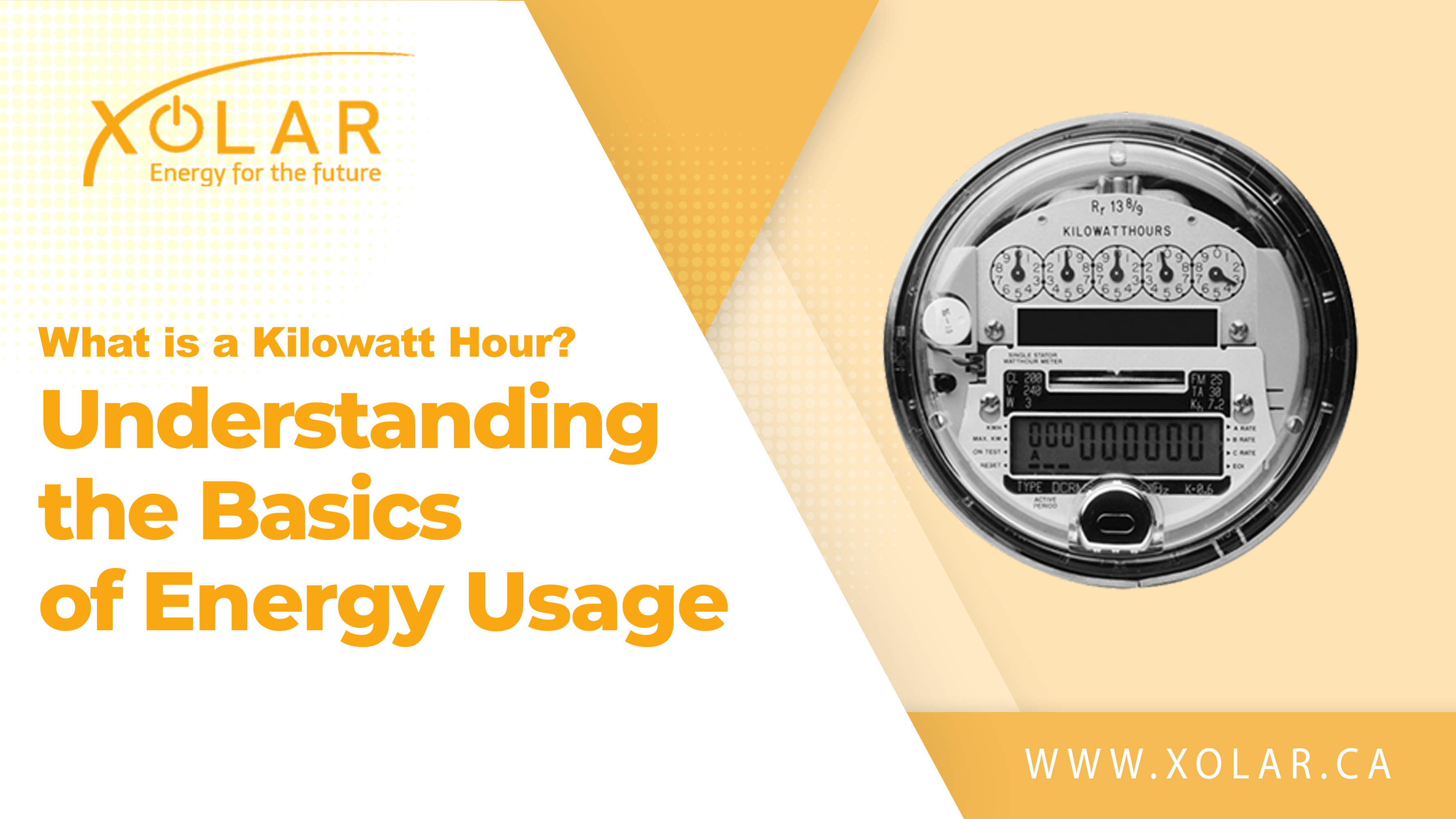
Quick answer: A kilowatt-hour (kWh) is a unit of energy equal to 1,000 watts used for one hour. A 100-watt bulb left on for 10 hours uses 1 kWh. Utilities bill you for each kWh you use, and the Ontario Energy Board uses 750 kWh a month as a typical Ontario household’s usage.
Key takeaways
- A kilowatt (kW) is power at one moment; a kilowatt-hour (kWh) is energy over time (power multiplied by hours).
- To find what an appliance uses, multiply its watts by the hours it runs and divide by 1,000.
- In Ontario, what you pay per kWh depends on your price plan and the time of day: from November 1, 2025 to October 31, 2026, Time-of-Use prices are 9.8¢, 15.7¢ and 20.3¢ (see Ontario electricity rates explained).
- Solar systems are sized from the kWh on your past year of bills, and with net metering, the kWh you export earn bill credits.
Defining a Kilowatt Hour
If you look at your electricity bill, you will notice the term “kilowatt hour” or “kWh” listed as a measure of your energy usage. In Ontario, the price of each kWh depends on your price plan and the time of day. Understanding exactly how much 1 kWh is can help you manage your energy usage better and see how a home solar system can offset the electricity you use.
A kilowatt hour (kWh) is a unit of energy that measures the amount of electricity you use over time. It’s not a measure of power at a single moment (which would be a kilowatt), but rather the amount of energy consumed when a device uses one kilowatt of power for one hour.
To put it simply, a kilowatt hour is the amount of energy required to run a 1,000-watt appliance for one hour. For example, if you run a 100-watt light bulb for 10 hours, you’ll have used 1 kilowatt hour of electricity (100 watts × 10 hours = 1,000 watt-hours, or 1 kWh).
How to Calculate Kilowatt Hours
To calculate how many kilowatt hours an appliance uses, you can follow these simple steps:
- Find the Wattage: Look for the wattage on the appliance label. Most devices will list how many watts they use.
- Determine the Time Used: Figure out how long the appliance runs in hours.
- Calculate Kilowatt Hours: Multiply the wattage by the number of hours the appliance runs. Then, divide by 1,000 to convert watts to kilowatts.
For major appliances you don’t need to measure: in Canada, the mandatory EnerGuide label shows the model’s annual energy use in kWh (Natural Resources Canada).
Examples of Kilowatt Hour Usage:
• 1 kWh: Running a 1,000-watt space heater for one hour.
• 2 kWh: Running a 500-watt appliance for four hours.
• 0.5 kWh: Running a 100-watt TV for five hours.
Why Kilowatt Hours Matter
Tracking how many kilowatt hours your home appliances and devices use can help you identify ways to reduce energy consumption. By cutting back on high-energy devices or using them more efficiently, you can lower your electricity costs.
Utilities charge for electricity based on the number of kilowatt hours you use, so the more kWh you consume, the higher the electricity line of your bill. The Ontario Energy Board (OEB) uses 750 kWh a month as the usage of a typical residential customer (OEB report). Ontario homes can choose Time-of-Use (TOU), Ultra-Low Overnight (ULO) or Tiered pricing. From November 1, 2025 to October 31, 2026, TOU prices are 9.8¢ per kWh off-peak, 15.7¢ mid-peak and 20.3¢ on-peak, and ULO ranges from 3.9¢ overnight to 39.1¢ on weekdays from 4 to 9 p.m. (OEB electricity rates). The OEB resets these prices every November 1. Running flexible loads, such as laundry or EV charging, in lower-priced hours will help you lower your bills.
Kilowatt Hours and Solar Energy
Solar Panels generate electricity in terms of kWh, so the more energy your household uses, the more solar panels you may need to cover it (see how many solar panels you need). As a solar installer, we use your historical kWh consumption right off your power bill to help size your system. The goal is to get you the most cost-effective solar system that can cover up to 100% of the electricity you use over a 365 day period, also known as achieving “Net-Zero”.
With grid-tied solar in Ontario, you can sign a net metering agreement with your power company. The excess energy you send to the grid, measured by a bi-directional meter, earns credits that cover the power you pull from the grid when your solar panels aren’t generating electricity, like at night. Credits carry forward for up to 12 months, then expire (O. Reg. 541/05). Homes that take the Home Renovation Savings Program solar rebate cannot net meter.
Under Ontario net metering, the electricity you export is valued on the same basis as the electricity you use, so on Time-of-Use pricing each exported kWh is credited at the price for the hour it was exported (O. Reg. 541/05). In summer, weekday on-peak (20.3¢) runs from 11 a.m. to 5 p.m., when panels produce the most, while evenings after 7 p.m. and weekends are off-peak (9.8¢). (This is how net metering works in Ontario.) Exporting at higher prices and using power at lower ones is a form of energy arbitrage, and understanding it helps you get the most from your home solar system.
Get your exact solar price
A free, no-obligation quote and custom design for your home — in about 24 hours.
Get Your Free Solar Quote
Get a personalized solar proposal in 24 hours
Prefer to discuss your project first? Contact us or view our detailed quote form
Frequently asked questions
What does kWh mean?
kWh stands for kilowatt-hour, a unit of energy. One kWh is the energy used when something draws 1,000 watts (1 kilowatt) for one hour, or 100 watts for 10 hours. Utilities use kWh to measure and bill the electricity you use, so your bill shows your usage for the billing period in kWh.
What is the difference between a kW and a kWh?
A kilowatt (kW) measures power: how fast electricity is used or produced at one moment. A kilowatt-hour (kWh) measures energy: the total used over time. A 2 kW heater running for three hours uses 6 kWh. Solar systems are sized in kW of panel capacity, while what they produce over a year is measured in kWh.
How long is a kilowatt-hour?
A kilowatt-hour is not a length of time; it is an amount of energy. How long it takes to use 1 kWh depends on the wattage: a 1,000-watt microwave uses 1 kWh in one hour, a 100-watt TV takes 10 hours, and a 10-watt LED bulb takes 100 hours. Divide 1,000 by the wattage to get the hours.
How do you calculate kilowatt-hours?
Multiply the device’s wattage by the hours it runs, then divide by 1,000. A 1,500-watt kettle used for 12 minutes (0.2 hours) uses 1,500 × 0.2 ÷ 1,000 = 0.3 kWh. For appliances that cycle on and off, like fridges and freezers, use the annual kWh on the EnerGuide label instead, or measure with a plug-in energy meter.
How many watts are in a kilowatt-hour?
A kilowatt-hour equals 1,000 watt-hours: 1,000 watts for one hour, 500 watts for two hours, or 250 watts for four hours. Watts measure power and kilowatt-hours measure energy, so you can’t convert one into the other without the time. Watts × hours ÷ 1,000 gives kWh.
How many kWh does a house use per month?
The Ontario Energy Board uses 750 kWh a month as the usage of a typical Ontario residential customer, about 9,000 kWh a year. Your own number can be much higher or lower: electric heating, an EV, a pool or a large home push it up. Your utility bill, or your online account with your utility, shows your monthly kWh history.
How much does 1 kWh cost in Ontario?
It depends on your price plan and the time of day. From November 1, 2025 to October 31, 2026, the OEB’s Time-of-Use prices are 9.8¢, 15.7¢ and 20.3¢ per kWh, Tiered prices are 12.0¢ and 14.2¢, and Ultra-Low Overnight ranges from 3.9¢ to 39.1¢. These cover the electricity line only; delivery and regulatory charges are added on top.
What does kWh mean on my electricity bill?
The kWh figure on your bill is the energy your home used during the billing period, read from your meter. On Time-of-Use or Ultra-Low Overnight pricing, the bill splits it by price period, such as off-peak, mid-peak and on-peak, and charges each part at its own price. If you net meter solar, the bill also shows the electricity you sent to the grid and your credit balance.
Own your energy by choosing XOLAR
Many homes can offset most of their yearly electricity use with solar, depending on roof space, shading and how much power they use. Having an understanding of how much energy your appliances use in kWh, how your power company charges you for that energy, and how big your solar panel system is can ensure that you are able to eliminate a significant portion of your electricity costs. With solar, you also get a number of monitoring technology to make monitoring your usage seamless.
Interested in learning more about going solar?
The first step is to acquire a solar proposal. By understanding your energy consumption, sunlight exposure, and roof orientation and space, we can design a solar solution that meets your needs both now and in the future. A well-sized solar system can help you achieve your energy goals and reduce your carbon footprint.
Our Solar Specialists and Project Managers can cleanly walk you through the steps of what is required and make sure you maximize the value of any provincial or federal programs in your area. We’ll also get you started on the vital first step of acquiring a tailor-made solar proposal for your residential project’s energy needs.
Schedule a consultation for our solar specialist’s expert guidance here.