What Is a Heat Pump? A Canadian Homeowner’s Guide (2026)
Quick answer: A heat pump is an electric system that heats and cools your home by moving heat instead of burning fuel. It can deliver about 3 units of heat for each unit of electricity it uses. Newer cold-climate air-source models keep working down to about -15 °C to -25 °C, with a backup heat source below that.
Key takeaways
- Air-source heat pumps, ductless or ducted, suit most Canadian homes. Ground-source systems hold their efficiency better in deep cold but cost more to install.
- Packages on our heat pump cost and packages page start at $13,997 for a one-zone ductless system and $14,997 for central ducted, installed, before rebates and tax.
- In Ontario, the Home Renovation Savings Program pays up to $7,500 for a cold-climate air-source heat pump in homes heated by electricity, oil, propane or wood, and up to $2,000 in gas-heated homes. Pre-approval is required.
- Below a heat pump’s minimum operating temperature, a backup heat source takes over.
- Natural Resources Canada puts the service life of an air-source heat pump at 15 to 20 years.
A heat pump is one device that both heats and cools your home — and because it moves heat instead of burning fuel to create it, it can deliver up to three times more energy than it consumes. For Canadian homeowners facing rising electricity and heating costs, a modern cold-climate heat pump is one of the most efficient ways to stay comfortable year-round, especially when paired with solar. Here’s how they work, what they cost, how they hold up in a Canadian winter, and the rebates that apply in 2026.
What is a heat pump?
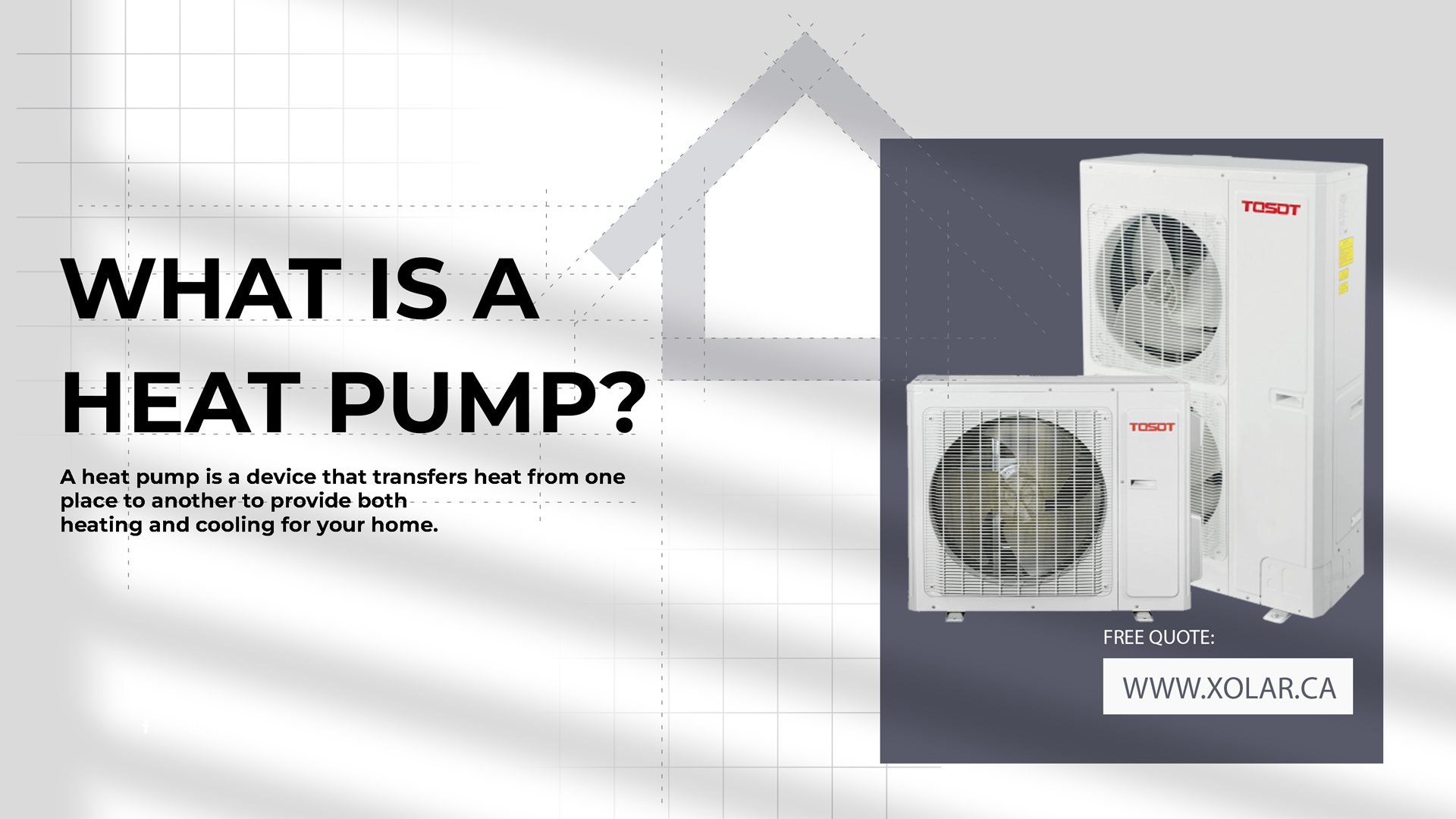
A heat pump transfers heat from one place to another to provide both heating and cooling for your home. Unlike traditional systems that generate heat by burning fuel or using electric resistance, a heat pump moves existing heat using a reversible version of the same vapor-compression process an air conditioner uses. In summer it pulls heat out of your home; in winter it pulls heat from the outside air (yes, even cold air contains heat) and moves it inside. That makes it a versatile, low-cost, year-round comfort solution.
Types of heat pumps
- Air-source heat pump (ductless mini-split or central/ducted): the most common and affordable type, it transfers heat between your home and the outside air. Ductless mini-split systems mount on the wall and are ideal for homes without ductwork or for zoning specific rooms (single- or multi-zone); central/ducted systems tie into existing ductwork to heat and cool the whole house.
- Ground-source (geothermal) heat pump: transfers heat between your home and the ground. Extremely efficient and consistent, but more expensive because of the trenching or drilling required.
- Water-source heat pump: uses a nearby body of water to transfer heat. Highly efficient where available, but uncommon for typical residential homes.
For most Canadian homes, an air-source heat pump — ductless or ducted — is the right balance of cost, size, and performance.
How does a heat pump work?
A heat pump moves heat rather than generating it, operating like a refrigerator or air conditioner that can run in reverse:
- Absorption: even in cold weather there is heat in the outside air; the heat pump absorbs it.
- Compression: that heat is compressed, which raises its temperature to a level useful for heating your home.
- Distribution: the heat is released indoors and distributed through your ducts or a wall unit.
In cooling mode the cycle reverses — the system pulls heat from inside your home and releases it outdoors, exactly like central air conditioning.
Do heat pumps work in Canadian winters?
Yes. This is the biggest misconception about heat pumps. Older units struggled in deep cold, but modern cold-climate air-source heat pumps are specifically engineered for Canadian winters — most newer models have a minimum operating temperature of between -15°C and -25°C, according to Natural Resources Canada’s heat pump guide. Below that, a supplemental heat source has to take over. In the coldest snaps, systems are typically set up with a backup electric or existing furnace stage (a “dual-fuel” or “hybrid” setup) so you always have full heat. For the vast majority of the heating season, the heat pump does the work far more efficiently than a furnace or baseboards. If you’re choosing equipment, look for a model on Canada’s cold-climate heat pump list.
Heat pump vs. furnace: which is better?
A gas or oil furnace burns fuel to make heat; a heat pump moves heat using electricity. Here’s how they compare:
| Heat pump | Gas/oil furnace | |
|---|---|---|
| Efficiency | Up to ~300% (moves heat) | 90–98% AFUE for condensing gas furnaces, per NRCan’s gas heating guide |
| Heating + cooling | Both, in one system | Heating only (needs separate A/C) |
| Fuel | Electricity (pairs with solar) | Natural gas, propane, or oil |
| On-site emissions | None | Combustion emissions |
| Very cold snaps | Backup stage recommended | Strong output in extreme cold |
| Upfront cost | Higher | Lower |
For most Canadian homes, a cold-climate heat pump (optionally with a backup stage) cuts on-site emissions and can lower operating cost, depending on your local electricity and fuel prices. If you generate your own electricity with solar, you can heat and cool your home on the power from your roof.
How much does a heat pump cost in Canada?
Cost depends on the type of system, your home’s size, whether you have existing ductwork, and how many zones you need. On the packages listed on our heat pump page (before rebates and tax):
- Ductless mini-split (single zone): from $13,997 installed
- Ductless multi-zone: add $3,497 for each extra indoor unit, up to 4 zones
- Central / ducted cold-climate system: from $14,997, with ductwork and the air handler extra
Ground-source (geothermal) systems cost more because of the drilling or trenching, but NRCan notes most keep a COP of around 3 even in the coldest months. Your exact price depends on your home, and the rebates below can reduce it.
Heat pump rebates & incentives (2026)
Federal and provincial programs can offset a meaningful share of a heat-pump project. If you heat with oil, the federal Oil to Heat Pump Affordability (OHPA) program paid up to $10,000 to switch, and NRCan says July 31, 2026 was the last day to apply in the provinces it serves directly. In Ontario, OHPA is co-delivered with the IESO through Save on Energy (NRCan’s page for participating provinces), where income-qualified, oil-heated homes can get a heat pump installed at no cost through the Energy Affordability Program; check with Save on Energy for its current status. Ontario’s Home Renovation Savings Program pays $1,250 per ton, up to $7,500, for a cold-climate air-source heat pump in homes heated by electricity, oil, propane or wood, and $500 per ton, up to $2,000, in homes heated by Enbridge natural gas. Ground-source systems can get up to $12,000 ($3,000 in gas-heated homes). Pre-approval is mandatory, and a participating HVAC contractor submits the application; see our Ontario heat pump rebate guide. For federal programs, see our federal heat pump rebate guide. Other provincial and utility programs vary by where you live and change often. See exactly which rebates apply to your address →
Get your exact solar price
A free, no-obligation quote and custom design for your home — in about 24 hours.
Get Your Free Solar Quote
Get a personalized solar proposal in 24 hours
Prefer to discuss your project first? Contact us or view our detailed quote form
Heat pumps and solar energy
Heat pumps pair exceptionally well with solar. Because a heat pump runs on electricity, powering it with solar panels lets you heat and cool your home on energy from your own roof — cutting your reliance on the grid and shrinking your bills. It’s the core of a net-zero home, and we cover it in more detail in Solar + Heat Pumps: the power duo.
Frequently asked questions
What is a heat pump?
A heat pump is an electric system that heats and cools your home by moving heat rather than burning fuel. In winter it pulls heat from the outside air, the ground or water and moves it indoors; in summer it reverses and works like an air conditioner. Because it moves heat, it can deliver about 3 units of heat for each unit of electricity it uses.
How do heat pumps work in Canada?
A refrigerant absorbs heat from the outside air, even on cold days, a compressor raises its temperature, and an indoor unit or your ducts release that heat into your home. Cold-climate models are built for Canadian winters, and NRCan says newer models can operate down to between -15 °C and -25 °C before a supplemental heat source is needed.
Do heat pumps work in cold weather?
Yes. Cold-climate air-source heat pumps are built for Canadian winters. According to NRCan, newer models have a minimum operating temperature of between -15 °C and -25 °C, and efficiency drops as it gets colder: at -8 °C, COPs range from 1.1 to 3.7. Below the minimum temperature, a backup heat source takes over.
Do I need backup heat with a heat pump in Canada?
In most of Canada, yes. Below a heat pump’s minimum operating temperature, a supplemental system has to supply the heat. That can be electric resistance heat built into the system, or your existing furnace in a dual-fuel setup. Above that temperature the heat pump does the work, and the backup only runs during the coldest snaps.
How much does a heat pump cost in Canada?
On the packages listed on our heat pump page, a one-zone cold-climate ductless system starts at $13,997 installed and a central ducted system starts at $14,997, before rebates and tax. Each extra indoor unit adds $3,497. In Ontario, the Home Renovation Savings Program can pay up to $7,500 toward a cold-climate air-source heat pump in homes not heated by natural gas.
Is a heat pump worth it in Canada?
It depends on what you heat with now, your electricity and fuel prices, your home’s insulation and the rebates you qualify for. In Ontario, homes heated by electricity, oil, propane or wood qualify for the larger rebate (up to $7,500, against $2,000 for gas-heated homes). A heat pump also replaces a central air conditioner, and NRCan puts air-source service life at 15 to 20 years.
What’s the difference between a ductless and a central heat pump?
Ductless mini-splits mount on the wall and are ideal for homes without ductwork or for zoning rooms; central/ducted systems use your existing ductwork to condition the whole home. Either type can qualify for Ontario’s Home Renovation Savings rebate if the model is on Natural Resources Canada’s qualified cold-climate list.
Is a heat pump cheaper to run than a furnace?
Often, but it depends on local electricity and fuel prices. NRCan gives the example of a heat pump moving 3 kW of heat for 1 kW of electricity (a COP of 3), while condensing gas furnaces are rated at 90 to 98% efficiency. A heat pump also replaces your air conditioner, so one system covers both heating and cooling.
Are there rebates for heat pumps in Canada?
Yes, depending on your province and heating fuel. Ontario’s Home Renovation Savings Program pays up to $7,500 for a cold-climate air-source heat pump in homes heated by electricity, oil, propane or wood, and up to $2,000 in Enbridge gas-heated homes, with pre-approval required. The federal OHPA program for oil-heated homes stopped taking applications on July 31, 2026, in the provinces NRCan serves directly.
How long does a heat pump last?
NRCan puts the service life of an air-source heat pump at 15 to 20 years, and a ground-source heat pump at about 20 to 25 years. Annual maintenance by a qualified contractor, and cleaning or changing the air filter every 3 months, help it reach that range.
Talk to Xolar
Thinking about a heat pump — on its own or paired with solar? Tell us about your home and we can connect you with a heat pump installer, explain which rebates may apply, and show how a heat pump fits with solar. Book a free consultation →