Quick answer: A farm solar system in Canada typically runs from about 25 kW on a barn roof to 100 kW or more on the ground. Xolar’s 2026 installed price for 25–100 kW systems is $2.40–$2.90 per watt before incentives, so a 50 kW system costs roughly $120,000–$145,000. Incorporated farms can claim the refundable federal Clean Technology tax credit of up to 30%; sole-proprietor farms cannot.
Key takeaways
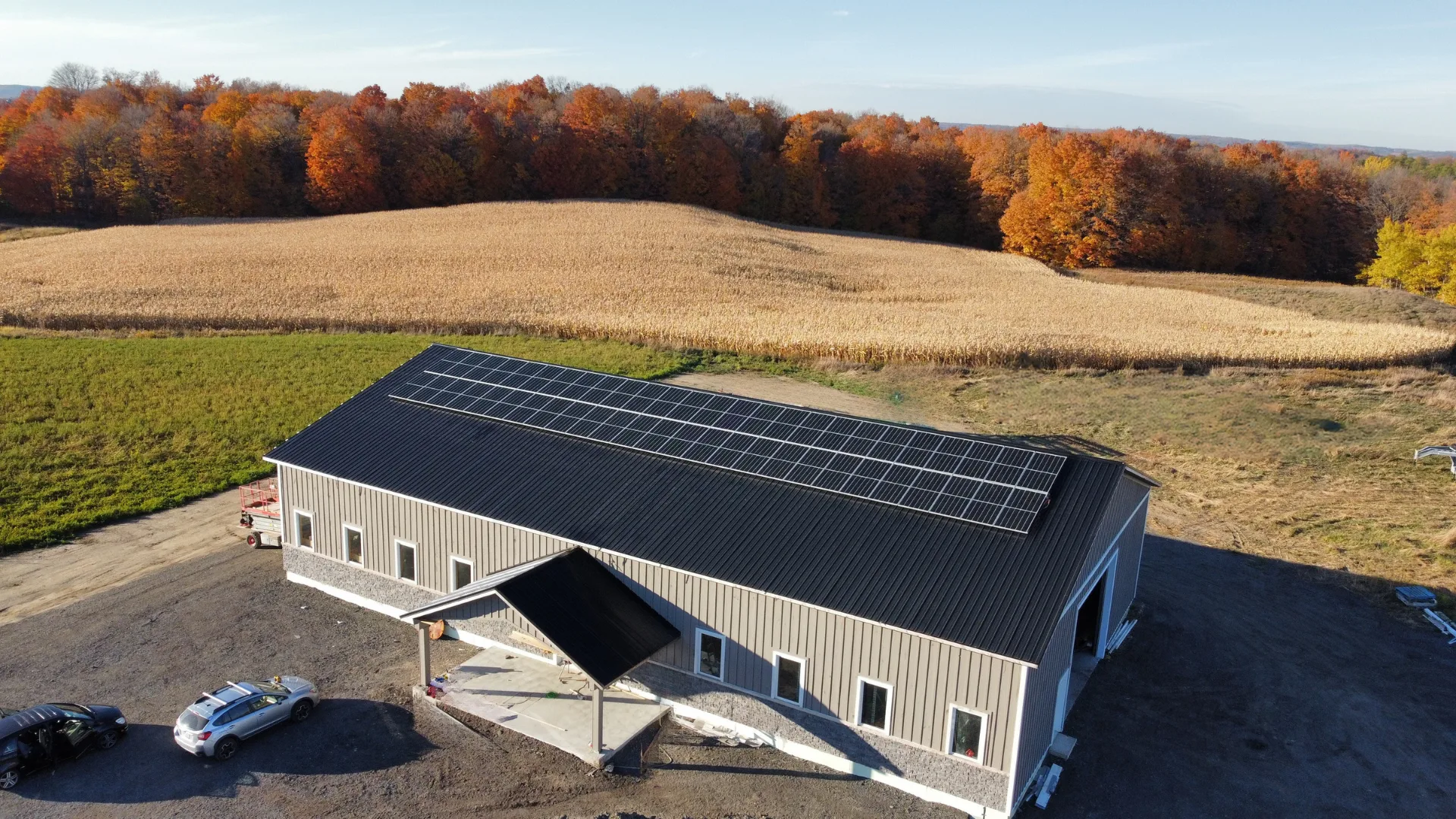
- Barn and shop roofs, machine sheds and open land are all workable sites. Roof systems avoid farmland rules; ground mounts avoid roof age and structure limits.
- The federal Clean Technology investment tax credit covers solar generation equipment and battery storage, but only taxable Canadian corporations (and certain trusts) can claim it, so how your farm is set up matters before you buy.
- The federal Agricultural Clean Technology (ACT) Adoption stream is closed: projects had to be completed by March 31, 2026, and no new intake has been announced as of November 2026.
- Net metering limits differ by province: Ontario removed its 500 kW cap in 2018, Alberta allows micro-generation up to 5 MW, and SaskPower caps net metering at 100 kW per customer meter.
- In Ontario, ground-mounted systems over 10 kW may be restricted on prime agricultural land, so check your land designation before planning a field array.
For business and larger installs, see our commercial solar installation page; this guide covers what is different on a farm.
Why farms are a good fit for solar
Farms often have what a solar system needs: large unshaded roofs on barns and sheds, open land for a ground array, and steady daytime electricity use from ventilation, water pumps, lighting, milk cooling, grain handling and shop tools. Daytime use matters because power you use as it is produced is usually worth more than power you send back to the grid.
A farm is also one business with several buildings, which gives you options a house doesn’t have: you can put the array on the building with the best roof, or on land, and size it to the farm’s annual use rather than one roof’s area.
Barn roof or ground mount?
Most farm systems are one of two types, and the choice usually comes down to the condition of your roofs and how you use your land.
| Barn or shed roof | Ground mount | |
|---|---|---|
| Land use | None: uses an existing roof | Takes land out of production for the life of the system |
| Roof requirements | Roof must carry the load and outlast the panels; older roofs may need work first | No roof needed |
| Orientation | Fixed by the building | Can face due south at the best tilt |
| Rules | Building and electrical permits | Building and electrical permits, plus farmland and environmental rules for larger arrays (see below) |
| Snow and maintenance | Harder to reach | Easy to reach and clear |
Before a roof install we check the structure, the roof covering and its remaining life. Metal roofs on newer barns are often good candidates. For a closer look at the trade-offs, see roof or ground mounting.
How much does farm solar cost in 2026?
Farm systems are priced like commercial systems. Xolar’s 2026 installed price ranges, before incentives and tax:
| System size | Installed price per watt | Example |
|---|---|---|
| 25–100 kW | $2.40–$2.90/W | 50 kW: about $120,000–$145,000 |
| 100–500 kW | $2.00–$2.40/W | 200 kW: about $400,000–$480,000 |
A smaller system on a farmhouse or shop, around 10 kW, is priced like a home system: about $27,200–$29,500 before tax on our current price list. Quotes include engineering, permits, installation and commissioning. Ground mounts, long trench runs to the electrical service and three-phase connections change the price, so every farm gets a site-specific quote.
How much power will it produce?
Across the systems Xolar monitors in Ontario, the median system produces about 930 kWh per year for every kW installed (Xolar monitoring data, 2026). At that rate:
- a 25 kW system produces roughly 23,000 kWh a year
- a 50 kW system produces roughly 46,500 kWh a year
- a 100 kW system produces roughly 93,000 kWh a year
Your result depends on orientation, tilt, shading and location. We size the system to your farm’s actual annual use from your utility bills, not to the largest array that fits.
The federal Clean Technology tax credit
The Clean Technology investment tax credit (ITC) is a refundable federal credit on the capital cost of eligible equipment. Eligible property includes “equipment used to generate electricity from solar” and fixed-location electrical energy storage (Canada Revenue Agency, what property qualifies). The rate is up to 30% for property acquired and available for use by December 31, 2033, dropping to 15% in 2034. Claimants that do not meet the program’s labour requirements get a rate 10 percentage points lower.
Who can claim it matters most for farms. The credit is available to taxable Canadian corporations, including corporations that are members of a partnership, and to certain real estate investment trusts (Canada Revenue Agency, who can claim). A farm run as a sole proprietorship or by individuals cannot claim it. If your farm is incorporated, the credit can bring a $120,000 system down to about $84,000; if it isn’t, talk to your accountant before you buy.
Solar equipment may also qualify for accelerated capital cost allowance under Class 43.1 or 43.2, which lets a farm business write off the cost faster. Your accountant can confirm how the credit and depreciation work together for your farm.
Are there farm solar grants?
Not at the federal level right now. The Agricultural Clean Technology (ACT) Program’s Adoption stream, which cost-shared clean technology purchases on farms, is closed to applications, and all projects had to be completed by March 31, 2026 (Agriculture and Agri-Food Canada). No new intake had been announced as of November 2026.
We did not find an open provincial program that pays for solar on farms as of November 2026. Provincial agriculture programs open and close in intakes, so check with your provincial agriculture ministry before you sign, and be wary of grant figures you can’t find on a government website. For programs that apply to homes and businesses, see solar rebates by province.
Get a free farm solar quote
A design sized to your farm's use, with the incentives your farm structure qualifies for.
Get Your Free Farm Solar Quote
Get a personalized commercial proposal in 24 hours
Prefer to talk it through? Call 1-877-965-2722
Net metering rules for farms by province
Net metering lets your farm send surplus power to the grid in exchange for credits on your bill. The size limits are what matter for a farm-sized system.
| Province | Size limit | How credits work |
|---|---|---|
| Ontario | No fixed cap: the 500 kW limit was removed in 2018 (Ontario Energy Board) | Credits offset future bills; leased and third-party-owned systems and paired storage have been allowed since July 1, 2022 (Hydro One) |
| Alberta | Micro-generation up to 5 MW (Government of Alberta) | Under 150 kW: credits at your retail rate, or the hourly wholesale price with a suitable meter. 150 kW and over: hourly wholesale price. A system can serve adjacent sites. |
| Saskatchewan | 100 kW DC per customer meter (SaskPower net metering guidelines) | Credits offset consumption charges only and carry forward; they are not paid out. Interconnection study $315; bi-directional meter from $498.75. |
Rules in other provinces vary by utility. We confirm your utility’s current limits and connection steps as part of every quote. In Alberta, how much your exported power is worth also depends on your retail plan; see Alberta electricity rates.
Ground mounts on Ontario farmland
Ontario’s guidance on prime agricultural areas says that “ground-mounted solar projects larger than 10 kilowatts may be restricted from being located on prime agricultural areas or on prime agricultural land” (OMAFA Publication 851). Rooftop systems on farm buildings are not covered by that restriction.
Separately, small ground-mounted solar facilities above 10 kW and up to 500 kW register through Ontario’s Environmental Activity and Sector Registry, and on a farm the total area of the facility can’t exceed three hectares (Ontario EASR user guide). If your best land is prime farmland, a barn roof or a less productive corner of the property is usually the simpler route; we check your land designation with you before designing a field array.
Adding a battery
A battery stores midday solar for evening loads and keeps critical equipment such as ventilation, water pumps and refrigeration running in an outage. Fixed-location battery storage is also eligible property for the Clean Technology tax credit (Canada Revenue Agency, linked above). See commercial energy storage for larger systems.
What a farm solar project looks like with Xolar
- Usage and site review: we look at 12 months of utility bills, your electrical service (single or three-phase) and the roofs or land you want to use.
- Design and quote: a system sized to your use, with production estimates and the incentives your farm structure qualifies for.
- Permits and utility approval: building and electrical permits, the net metering or micro-generation application, and any farmland registration.
- Installation and inspection: installation by our crews, electrical inspection and utility connection.
- Monitoring: the system’s monitoring shows what it produces, so you can check it against the estimate.
Frequently asked questions
How much do solar panels for a farm cost?
Xolar’s 2026 installed price for 25–100 kW systems is $2.40–$2.90 per watt before incentives and tax, so a 50 kW system costs about $120,000–$145,000. Systems of 100–500 kW are $2.00–$2.40 per watt. A 10 kW system is about $27,200–$29,500 before tax.
Can my farm claim the 30% federal solar tax credit?
Only if the farm is a taxable Canadian corporation (or a corporate member of a partnership). Sole-proprietor farms and individuals cannot claim the Clean Technology investment tax credit. The full 30% also depends on meeting the program’s labour requirements.
Are there grants for solar on farms in Canada?
Not at the federal level right now: the Agricultural Clean Technology Adoption stream is closed, and projects had to be completed by March 31, 2026. We found no open provincial farm solar program as of November 2026.
Can I put solar panels on my barn roof?
Usually, if the roof structure can carry the load and the roof covering will last as long as the panels. We inspect the building first; older roofs may need repair or replacement before an install.
Can I put a ground-mounted solar array on farmland in Ontario?
Ground-mounted systems over 10 kW may be restricted on prime agricultural land under Ontario’s guidance, and systems from 10 kW to 500 kW register through the Environmental Activity and Sector Registry, with a three-hectare limit on farms. Roof systems are not affected by the farmland restriction.
How big a solar system can a farm net meter?
It depends on the province. Ontario removed its 500 kW net metering cap in 2018, Alberta allows micro-generation up to 5 MW, and SaskPower allows up to 100 kW DC per customer meter.
How much electricity will a 50 kW farm system produce?
In Ontario, about 46,500 kWh a year, based on the median of about 930 kWh per kW that Xolar’s monitored Ontario systems produce. Output depends on orientation, tilt, shading and location.
Does solar work on a farm in winter?
Yes, at lower output: days are shorter and snow can cover panels. Annual production figures already include winter. Ground mounts are easier to clear of snow than barn roofs.
Thinking about solar for your farm? Get a free farm solar quote with a design sized to your farm’s use and the incentives your farm structure qualifies for.