Roof or Ground Mounting Which Is Better for Home Solar?
Is Roof or Ground Mounting Better for Home Solar?
Aside from the panels and inverter you choose for your solar project, the next most important factor is where and how you are mounting your system. Your two options would be either to mount the panels on your roof, or to ground mount the panels. Both methods have their merits, but roof mounting is often the superior choice for residential solar installations. Let’s compare the two methods and their benefits.
What is a Roof Mount?
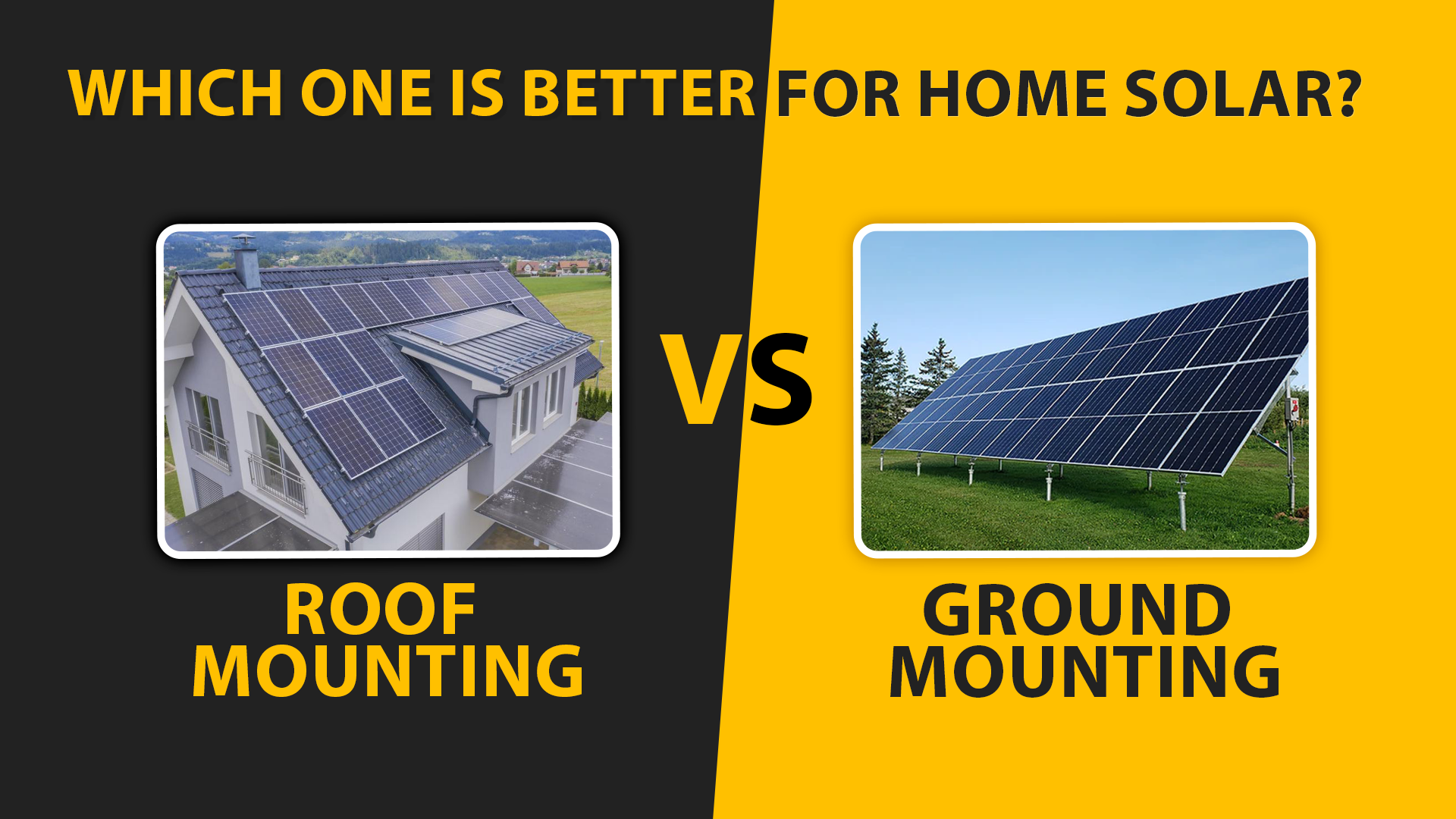
A roof mount is a method of installing solar panels directly onto the roof of your home. This is the most common installation method for residential solar systems. The panels are attached to the roof using a racking system, which secures them in place on the most sunlight exposed portions of your roof and uses your homes natural roof slope to get the best angle on solar rays.
How Roof Mounts Work:
Racking System: The solar panels are secured to your roof using a specialized racking system. This system is designed to withstand various weather conditions, ensuring that your panels stay in place and function efficiently.
Panel Orientation and Tilt: The racking system uses the natural pitch of your roof to get the best angle on sunlight. Canada is in the northern hemisphere, so our most direct sunlight comes from the south. This means solar panels would be placed on a south facing roof, or if your home has an east/west orientation then some will be placed on both sides to capture sunlight from both morning and evening.
Minimal Roof Impact: Modern roof mounting systems are designed to have minimal impact on your roof. They are installed with care to prevent leaks or damage.
Advantages of Roof Mounts:
Space Efficiency: Roof mounts stylishly utilize the existing space on your roof, making them ideal for homes with limited yard space. This leaves your yard neat and free for other uses.
Cost-Effectiveness: Roof mounts are much more cost-effective than ground mounts. Since they don’t require additional land preparation, trenching, or complex racking systems the installation costs are lower.
Aesthetics: Roof-mounted solar panels are often more visually appealing, as they blend seamlessly with the roofline. Ground-mounted systems, on the other hand, can be more conspicuous and may not be as visually integrated with your property. Solar increases your home value. If you end up selling your property you also want to make sure your solar install is aesthetically pleasing by putting it on your roof.
Optimized Sunlight Exposure: Roof mounts take advantage of your home’s height to capture more sunlight, especially if there are trees, buildings, or other obstructions in your yard. This will lead to better overall energy production compared to ground-mounted systems that may be subject to shading at some points of the day.
Comparing Roof Mounts to Ground Mounts
While roof mounts are popular, ground mounts may be needed for certain solar projects. Ground mounts involve installing solar panels on a racking system that is anchored to the ground in your yard or another open space on your property.
Situations Where Ground Mounts Might Be Preferred:
Limited Roof Space: If your roof is too small to accommodate the number of panels you need, a ground mount might be a better option. This is more common in homes with irregular roof shapes that have many obstructions like chimneys or skylights.
Commercial Projects: We’ve all seen pictures of big fields of solar panels. Ground mounting is best used in larger scale commercial projects where there is a huge amount of space to cover with panels.
Flexibility: Ground mounts offer more flexibility in terms of orientation and tilt, which can be adjusted easily if necessary.
Why Roof Mounts Are Superior for Most Home Solar Installations
For most homeowners, roof mounts are going to be the better choice for your home solar installation. Ground-mounted panels are more suited to very large commercial projects that require a large amount of space. Most homes only need about 15-20 solar panels to cover 100% of their power bills, making ground mounting a less-needed option for residential systems. Roof mounting is cheaper, blends better with the overall look of your home, and uses your home’s natural elevation and slope to get the best angle of sunlight.
Our Solar Specialists and Project Managers can cleanly walk you through the steps of what you need for your solar project as well as making sure you maximize the value of any government rebates in your area. We’ll also get you started on the vital first step of acquiring a tailor-made solar proposal for your personal energy needs at home.
One of the first questions that need to be answered if you are going solar is exactly how many panels you need to buy. The answer isn’t one-size-fits-all because the number of solar panels required depends on several factors unique to your home and lifestyle. Too few panels would mean you aren’t covering enough of your power bill for it to be of value; too many panels means that you might be overpaying since most provinces don’t let you liquidate your Net Metering credits as cash. There is a sweet spot where you are producing just enough energy and excess credits to cover your bill over a 365-day period.
What factors influence your system size?
Let’s look through some of the factors that influence your system size – and don’t be overwhelmed, we will build a solar proposal for you based on all of these factors.
Roof Space: The amount of available roof space can limit the number of panels you can install. If space is limited, you may need to choose higher-wattage panels to maximize energy production. We only use Tier 1 panels, which are the highest wattage and most value since they can last 30 to 40 years.
Roof Orientation: Since Canada is in the northern hemisphere of the Earth, we get all our most direct sunlight from the South. If your roof is facing south then you have an optimal property for solar. This doesn’t rule out east/west facing roofs though, you can design systems where your east facing panels capture the early day sunlight and the west captures the sunlight of the afternoon. Roofs with steeper slopes are also favorable for solar.
Sunlight Exposure: Roof Space and Roof orientation directly affect sunlight exposure but also some provinces tend to get more direct sunlight than others. The amount of sunlight your location receives directly affects your solar system’s output. Areas with more sunlight require fewer panels to generate the same amount of electricity.
Assess Your Yearly Energy Consumption: Your electricity bill is a good source of information—look for the section that shows your yearly consumption in kilowatt- hours (kWh). This figure represents the total amount of electricity your household uses over the course of a year, taking into account seasonal fluctuations.
Future Energy Needs: Consider whether your energy needs might increase in the future. For example, if you’re planning to add an electric vehicle (EV) or expand your home, you might want to install additional panels now to accommodate higher energy consumption later.
Understanding Solar Panel Output
The output of a solar panel is measured in watts, and panels come in a range of sizes, typically from 250 watts to 400 watts. Like I said earlier, we only use Tier 1 panels which are produce above 400 watts and last 30 to 40 years. The total energy production of a panel is calculated by multiplying its wattage by the number of hours it is exposed to sunlight each day under optimal conditions.
For instance, if you have a 400-watt solar panel and your location receives an average of 5 sunlight hours per day, that panel would produce 2,000 watt-hours or 2 kWh of electricity per day. Of course, not every day is optimal and our solar proposals are very conservative estimates that factor in average amounts of cloud cover over the year.
Calculating the Number of Panels
To determine the number of panels you need, divide your average monthly electricity consumption by the average monthly output of one panel. Of course, this is also impacted by factors listed above like your roof orientation and pitch, sunlight exposure, and future energy needs. We do all the calculations of the other factors for you. Most homes can cover their power bills on a system size of about 15-20 solar panels. Factoring in roof space, most of our clients can cover between 90-100% of their energy bills by going solar with the panels we use.
Upsizing Your Solar System
One of the advantages of solar energy is the ability to upsize your system over time. If your energy needs increase, you can add more panels to your existing system, provided you have the roof space and your inverter can handle the additional capacity. Upsizing allows you to start with a system that meets your current needs while keeping the option open for future expansion.
Get the most out of your home solar system with XOLAR
If this sounds overwhelming, don’t worry – there is an easy path forward. The first step is to acquire a solar proposal. By understanding your energy consumption, sunlight exposure, and roof orientation and space, we can design a solar solution that meets your needs both now and in the future. A well-sized solar system can help you achieve your energy goals and reduce your carbon footprint.
Our Solar Specialists and Project Managers can cleanly walk you through the steps of what is required and make sure you maximize the value of the provincial or federal programs in your area. We’ll also get you started on the vital first step of acquiring a tailor-made solar proposal for your residential project’s energy needs.
String vs Micro Inverters: Which is better for your home?
What is a solar inverter?
When it comes to installing solar for your home, it’s important to select a provider that uses high quality panels, but the next most important component in your system is your solar inverter. There are two types of solar inverters: the string inverter and the micro- inverter. But what exactly is a string inverter, and how does it compare to micro inverters? We’ll break down both types of inverters below and go over why a string inverter is the best option for residential solar systems.
Solar panels generate direct current (DC) electricity from sunlight. However, most homes and appliances use alternating current (AC) electricity. The inverter’s job is to convert the DC electricity produced by the solar panels into usable AC electricity for your home.
What is a String Inverter?
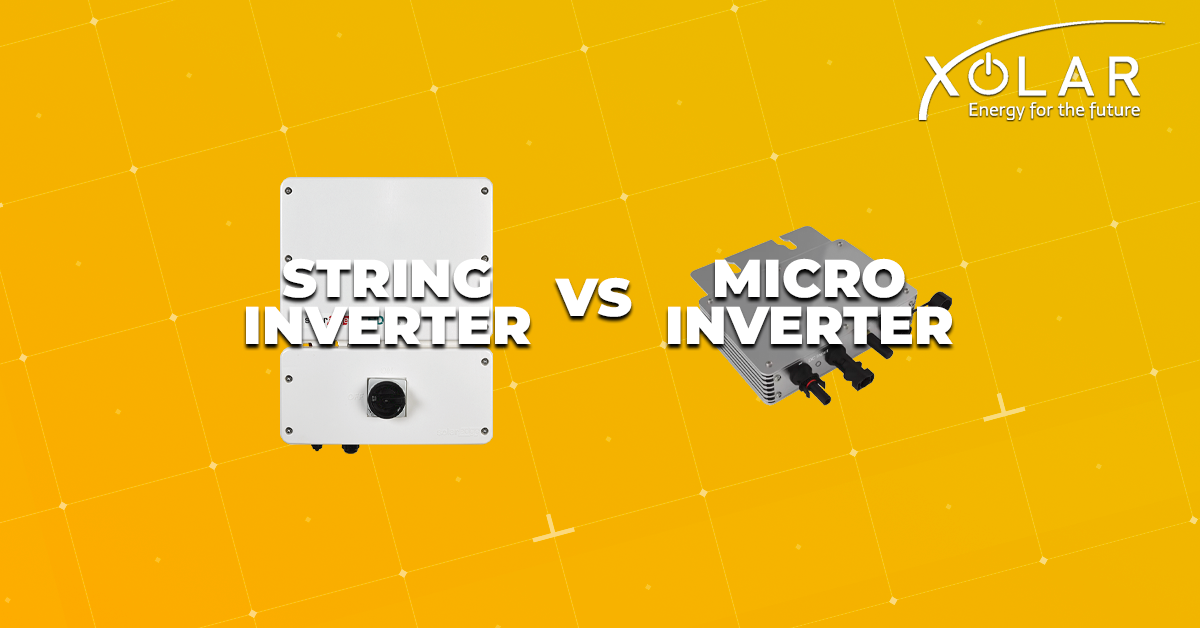
A string inverter is a central inverter that connects a series (or “string”) of solar panels together. All the DC electricity generated by the connected panels is sent to a single inverter, where it is converted into AC electricity.
How String Inverters Work:
Panel Connection: Solar panels are connected in series, forming a “string.” Multiple strings can be connected to a single string inverter. Essentially your entire solar installation would be connected to the one string inverter.
Centralized Conversion: The DC electricity from the entire string is fed into the string inverter, which converts it to AC electricity. AC electricity is the type of electricity that is usable by your home and the grid.
Power Distribution: The converted AC electricity is then distributed to your home for use, with any excess potentially being sent back to the grid through net metering.
What is a Micro Inverter?
A micro inverter is a small inverter installed directly on each individual solar panel. Instead of a single inverter handling the conversion for multiple panels, each panel has its own dedicated micro inverter that converts the DC electricity to AC right at the source.
How Micro Inverters Work:
Panel-Level Conversion: Each solar panel has its own micro inverter attached to it. The DC electricity generated by each panel is converted to AC immediately by its respective micro inverter.
Independent Operation: Since each panel operates independently, shading, dirt, or damage to one panel doesn’t significantly affect the output of the others.
Power Distribution: The AC electricity from each panel is then combined and sent to your home for use, just like with a string inverter system.
Comparing String Inverters and Micro Inverters
While both string inverters and micro inverters serve the same basic function—converting DC to AC electricity—they do so in different ways, with distinct advantages and disadvantages.
Advantages of String Inverters:
Cost-Effective: String inverters are generally more affordable than micro inverters, both in terms of initial cost and long-term maintenance. This makes them a more cost-effective solution for most home solar installations.
Proven Reliability: String inverters have been used for decades in solar installations and have a proven track record of reliability. They are robust and durable, making them a dependable choice for homeowners. For example, in a 20 panel home solar system, micro-inverters have a 2% failure rate each year where one might need to be replaced. String inverters are much more suitable for home solar systems because they are more durable and reliable than micro-inverters.
Simpler Installation and Maintenance: Since only one string inverter is needed for an entire solar system, installation is simpler and often quicker than with micro inverters, which require individual installation on each panel. Also, because string inverters are much more durable than micro-inverters, your solar system with a string inverter has next to no maintenance.
Efficient in Unshaded Areas: If your roof is free from shading and your panels are installed at the same angle and orientation, a string inverter system will operate efficiently, maximizing the energy production from your solar panels.
Advantages of Micro Inverters:
Panel-Level Optimization: Micro inverters optimize the performance of each individual panel. This means that the panels may operate more efficiently, but this level of optimization is only needed on large scale commercial systems. With a smaller home solar system, the added benefit of micro-inverters doesn’t outweigh the added maintenance of replacing each individual inverter when it fails. Micro- inverters are more suitable for commercial systems that may have hundreds of panels.
Scalability: If you plan to expand your solar system in the future, adding more panels is easier with micro inverters since each new panel simply gets its own inverter.
Increased Monitoring Capabilities: Micro inverters often come with panel-level monitoring, allowing you to see the performance of each individual panel. This can help identify issues more quickly. This is important for micro-inverter based systems since an individual inverter may fail and need replacing in this setup.
Why String Inverters Are Often Better for Home Solar Installations
String inverters are the better choice for home solar installations. The lower cost of string inverters makes them a more budget-friendly option, allowing homeowners to invest in higher-quality panels or other system enhancements. With fewer components to install and maintain, string inverters simplify the installation process and reduce the likelihood of failure. This results in a system that is easier to manage and more reliable over the long term. A homeowner wouldn’t want a system that requires they monitor the panel efficiency often and have to schedule replacements for parts.
If your roof is unshaded and your panels are installed uniformly, a string inverter system will also deliver excellent performance without the added cost of micro inverters. With only one inverter to monitor, maintenance is straightforward and constant monitoring isn’t required.. In the event of a rare string inverter failure, repairs are simpler and less expensive than dealing with multiple micro inverters.
Get the right system for your home with XOLAR
If you’re looking to do a commercial project, then micro inverters might be an option you choose. Even in the event of a commercial install, you may choose to go with multiple string inverters to simply your maintenance.
A homeowner looking to install solar for their personal energy needs would want to choose a string inverter. Not only does it cost you less, but its more reliable and durable than micro-inverters. The goal of solar is to fully cover your electricity bills without you having to add another worry to your life about something that needs to be managed. This is why string inverters are the best choice for your personal home solar system.
If you’re looking to go solar, our Solar Specialists and Project Managers can cleanly walk you through what type of system is needed to cover your energy needs and make sure you maximize the value of any government programs in your area. We’ll also get you started on the vital first step of acquiring a tailor-made solar proposal for your personal energy needs at home.